
Pughtown’s undertaker, casket-maker
Old and impoverished, Ruth Melvin walked through Pughtown, a living reminder of its promising early days
Trending
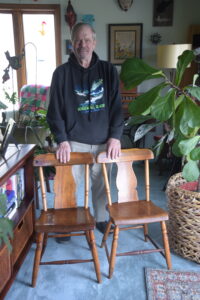
PUGHTOWN, W.Va. - A lifetime ago John H. Mayhew said to his daughter-in-law, Betty, "I've got three priceless chairs here for you to refinish."
When she got a look at the three ordinary kitchen chairs, so old, worn and loose in the joints that they were falling apart, she replied, "Priceless? They look like crap to me."
This story about the chairs comes from Shields "Skip" Mayhew, son of Betty and Shields Senior. Skip resides on the outskirts of New Manchester, the Hancock County, W.Va., hilltop village formerly known as Pughtown, in a house that was part of the Mayhew farm and Hancock County Poor Farm run by his parents.
"He knew the story behind the chairs that made them priceless," Skip said, "and he knew Mom had refinished a ton of antiques."
Skip said his uncle Robert Mayhew long wanted to obtain a chair made by Jim Melvin.
"Uncle Bob looked and looked for 20 years. He finally got one off Louise Cook. It was in pieces. He was going to put it together but died before he ever did."
(One other Melvin chair is known at this writing, in the possession of Rex Milner of Newell. It came through Howard Wright, who got it from among an antique chair collection amassed by Ed Strachan.)
What makes these chairs valuable to old Pughtown families is that they were built by James T. Melvin, undertaker and casket-maker, in the "furniture factory" beside his funeral business.
Skip said his grandfather John "was born in '82 and he would have known Melvin for sure." James T. Melvin's father James H. Melvin lived to 1898, so John Mayhew would have known both.
Long after most locals had forgotten, if they ever knew, about Jim Melvin's funeral and furniture businesses, his only daughter Ruth was a living reminder to those Pughtown residents who did remember.
Ruth Melvin was only 18 when her father died of a stroke in 1914. Ruth lived to age 77, dying in 1973. Impoverished and living alone in a derelict house in her last decades, Ruth Melvin was a sad but familiar figure often seen walking through Pughtown, stooped with age, a dark shawl around her shoulders. The old two-story house was located on a wooded lot adjacent to the Pughtown elementary school. Local children whispered that the house was haunted and a witch lived there. Braver ones would peek in her windows on a dare.
The story passed down is that Melvin made furniture from the scraps of wood left over from building coffins. Probably he learned undertaking and woodworking from his father, James H.
Melvin, who in the 1880 U.S. Census showed him residing in Pughtown with wife and three children and gave his occupation as "undertaker."
By a happy coincidence, the ladies of the Tri-State Genealogical and Historical Society, who researched the Melvin family history for this article, were already doing a fundraising project of selling reprints of an historical scrapbook about Pughtown. Assembled by Erma Huff and originally printed in 1981, the booklet is titled "Up High and Down Main (Sts.) in Pughtown, W.Va." The cost is seven dollars. Erma Huff chaired the town's elaborate observance of the U.S Bicentennial in 1976.
Among the miscellaneous old pictures, clippings and reminiscences about Pughtown is an uncredited article titled "Coffin and Furniture Factory, Lot 26." (Lot 26 at the corner of High and Ohio streets in more recent years held Vivian Crow's home and florist shop.)
"Jim Melvin, owner and operator, was also a practicing undertaker, the only one (sic) ever to be in New Manchester," the article states.
"Mr. Melvin made caskets of wood, in the shape of a body. The last casket made was used by the American Mechanics Lodge in their initiation ritual. When this lodge dissolved, the casket was given to Ben Fullerton who kept it for some time. He then gave it for the burial of Mrs. Reed who was burned in a fire.
"Mr. Melvin built tables, rocking and straight chairs, some of which are still around today."
In those years it was customary, the article says, for the undertaker to hire a white hearse and team of white horses when the deceased was an infant or young person. In snowy weather, a sled bore the coffin to the cemetery. There was even a sled maker in Pughtown.
"The last hearse used by Mr. Melvin was stored behind the barn of the Jay Moore farm, where it stood as a reminder that death will come to all. The elements finally brought it to ruin and decay," the article states.
Research by the Tri-State Genealogical and Historical Society show James Thayer Melvin was born in 1850, month and day not listed. His father was John Henry Melvin (1836-1898) and mother was Susan Andrews Melvin (1838-1891). Siblings were John Cowl Melvin (1862-1922), Philena "Lena" Melvin Bendure (1865-1942) and William "Paul" Melvin (1869-1924).
James T. Melvin married Elizabeth June Herron (b. 1864) in 1895 and one year later they had a daughter, Ruth A. Melvin, born Feb. 8, 1896.
Her father died on Nov. 19, 1914, aged 63 or 64. Her mother Elizabeth lived to 1940.
An undated obituary clipping passed to Skip Mayhew by Sherry Allison Stoker is headlined, "Death claims James Melvin." It said he suffered a stroke and died at around 9 o'clock in the evening at his home. Services were to be held at the Presbyterian Church, with burial in the Methodist Cemetery.
"He had been in the undertaking business in Pughtown for many years, was county assessor for several terms and at the time of his death was a member of the board of equalization," according to the obituary, which mistakenly listed his age as 53. It noted his middle name honored his uncle, Judge Thayer Melvin, an attorney and the only judge to sit in court when the Hancock County seat and courthouse was situated in Pughtown,1848 to 1881.
Ruth's house was dilapidated but contained some fine antique furniture, Skip said.
Ruth and his mother Betty Mayhew "were pretty close. When it got really cold Mom would go and get her," and she would stay in a room of their house at the poor farm.
K.J. Allison, who, Skip said, may have a family connection to the Melvins, bought the property so that Ruth would have some money but be able to keep living there.
Ruth Melvin died Aug. 31, 1973, and was buried in the Methodist Cemetery. Whatever good furniture that remained in her house was carried off by someone.
Bits of printed history, stories handed down in families, living memories of those who remember Ruth Melvin, and at a few priceless chairs tell of Pughtown's undertaker, who built his own coffins and crafted simple, charming furniture from the scrap wood.
******
After this article was written, George Hines provided a sort of postscript to the Melvin story. George, who authored two books of New Cumberland history, found two documents of interest in his files. One is an invoice to J.T. Melvin from the Freedom Casket Company of Freedom, Pa., dated Oct. 27, 1914.
The invoice, marked paid, is for a "6/o #64 Black" which may be interpreted as a six-foot black casket, price $8, plus a box for shipping, $4, "handles & plate," $2.75, "Lining & Trimming," $2.25, "Gents robe," $3, and a dozen black gloves, $1.25, total for casket and accessories, $22.50.
James T. Melvin died suddenly of a stroke less than a month after ordering a coffin from someone else. Why didn't he build it himself? Had he quit or cut back on casket-making? Was he too busy, or already ill from the impending stroke?
The other document is the playbill for a farce titled "The New Doctor," presented Dec. 23, 1921, by "The Community Club of Pughtown, W.Va." The last names of cast members will be familiar to locals: C.A.S. Hill as the new doctor, J.A. Gracie as the jolly bachelor judge, V.H. Huff as a young Irish butler, T.J. Wern as a cop, plus Edith Virden, Nora Ramsey, Marjorie Fink, Esther Beaumont . . . and playing the part of the doctor's girl, Maggie. . . Ruth Melvin.
Those who remember the old Ruth Melvin of the 1960s and '70s should, perhaps, try to see her as that outgoing, perhaps vivacious, young woman of 25, acting a bubbly part in community comedy.