
ACROSS THE NATION
Trending
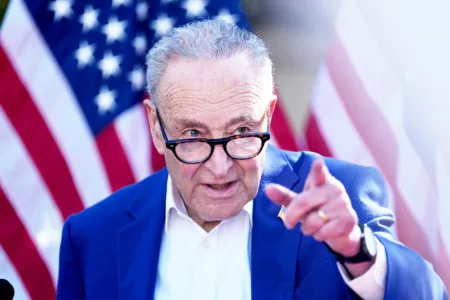
Senate Democrats will not let Trump put a 'right-winger' on the Supreme Court, Schumer vows
WASHINGTON (AP) -- Senate Democratic leader Chuck Schumer is vowing that Democrats will not allow President Donald Trump to put "a right-winger" on the Supreme Court once they take power, raising the possibility that his party could block a presidential nominee if there is a vacancy in the next two years.
In an interview with The Associated Press on Thursday, Schumer would not say if he would hold a Supreme Court vacancy open until after the next presidential election, as former Senate Republican leader Mitch McConnell did in 2016. But he said that Democrats are "not going to allow any crappy nominees" to be confirmed to the Supreme Court -- or to the lower courts or Trump's Cabinet, either.
"The bottom line is we're not going to allow a right-winger on the court," Schumer said.
Schumer's pledge came two days after Democrats won a decisive Senate majority in the midterm elections -- a feat few predicted a year ago, when Schumer was facing intense criticism from progressives within his party and Senate Republicans were betting that a favorable map and backing from Trump would help them keep power.
While there is still frustration with Schumer in some corners of the party, the New Yorker is expected to easily be reelected as leader by his caucus after leading them to wins in Republican-leaning states across the country. Democrats could have as many as 56 seats in the Senate if they win Mississippi and Alaska, which still have not been called -- "a durable majority," Schumer predicts, that has been 20 years in the making as he has been directly or indirectly in charge of his party's Senate campaign operation.
With so many seats, Schumer is betting that "it's not just a flip of the Senate once." And the party will have the power not only to reject any of Trump's nominees, forcing him to seek more moderate choices, but also to halt the Iran war and alter policies that they have been unable to counter in the minority.
Schumer says the party's agenda will center around lowering prices, along with five issues that they have focused on in the minority -- healthcare, housing, Trump's tariffs, childcare and lowering energy bills. Democrats also want to investigate Immigration and Customs Enforcement raids across the country and scrutinize the Trump administration, which he says is the "most corrupted administration by far in American history."
But Schumer would not get into specifics, or how he plans to get around Trump -- who posted a picture of a red hat with the word "veto" in large letters on election night.
Trump signs proclamation he says will prevent future changes to the Oval Office and Cabinet Room
WASHINGTON (AP) -- President Donald Trump on Thursday signed a proclamation that he said will prevent future changes to the Oval Office and Cabinet Room as he has redesigned them.
"We're making it a national monument and it will not be allowed to be touched by anybody," Trump told reporters in the Oval Office.
Trump's proclamation signing comes two days after voters, dissatisfied with his economic policies, threw dozens of Republicans out of office, delivering control of Congress to Democrats.
It's also the third day this week in which the president, a real estate mogul, delivered remarks fixated on his pet projects in Washington, D.C., including an opulent ballroom and the Lincoln Memorial Reflecting Pool.
Since returning to the White House, Trump has overseen numerous design changes to various rooms, including the Oval Office, where he has filled the wall space with portraits, a copy of the Declaration of Independence and numerous golden accents.
Trump meets at the White House with Putin envoy after he appeared with Melania Trump
WASHINGTON (AP) -- President Donald Trump said he met with Russian President Vladimir Putin's envoy at the White House on Thursday but did not meet with Ukrainian officials who were also visiting.
Speaking to reporters in the Oval Office, Trump said he wouldn't discuss his conversation with Kirill Dmitriev, but he suggested that some type of deal is in the works.
"There's going to be an agreement, it's going to be a big agreement and it's going to involve more than Ukraine," Trump said, adding that it might include all of Europe.
Asked if he had met with Ukrainian representatives, Trump said he had not. Representatives from both countries were at the White House for an event recognizing first lady Melania Trump 's work brokering a ceasefire in the Ukrainian village of Oleshky.
Speaking at her invitation at the event earlier Thursday, Dmitriev thanked the first lady for her "distinguished humanitarian role" in securing the six-day truce.
Dmitriev added that Putin personally gave instructions as part of the operation and sent his thanks to Melania Trump. Officials from Ukraine also participated in the event recognizing the ceasefire, which was signed Oct. 23.
The head of the parliamentary faction of President Volodymyr Zelenskyy's party, Davyd Arakhamia, and Ukraine's human rights ombudsman, Dmytro Lubinets, also spoke at the event.
Arakhamia told the first lady she did an "amazing job" and encouraged her to keep helping the Ukrainian people, who have endured more than four years of war after Putin sent his troops across the border and invaded the country in 2022.
"Definitely we would like to ask you to keep going and to find new missions and to de-escalate more as much as possible," Arakhamia said.
California Gov. Newsom says he will commute all death sentences in state to life without parole
SACRAMENTO, Calif. (AP) -- California Gov. Gavin Newsom said Thursday that he'll change more than 500 death sentences in the state to life in prison without the possibility of parole, though the state Supreme Court will have the final say in hundreds of those cases.
"I take this action because I firmly believe that state-sanctioned killing is incompatible with California's values, undermines the foundations of our legal system, and diminishes each of us," Newsom said in a public letter.
Newsom's decision comes as he prepares to leave office after eight years and considers a run for president. The Democrat, who's long been opposed to the death penalty, placed a moratorium on executions in California in 2019.
His latest move came after he realized "the limits of what government can justly accomplish," he said.
Newsom moved to grant clemency to 548 people currently sentenced to death in California, of whom 529 are men and 19 are women, according to numbers provided by his office.
The state constitution requires the California Supreme Court's approval to grant clemency to anyone convicted of a felony more than once, which means the court would have to approve 382 of those commutations, or roughly 70%, according to Newsom's office.
Americans have long been divided over the death penalty. Nearly half of U.S. states have banned capital punishment outright, but executions are still carried out routinely around the country. On Thursday alone, Florida, Alabama and Indiana were scheduled to perform lethal injections.
Californians voted to uphold the death penalty in 2012 and 2016 ballot measures. No one has been executed in the state since 2006 and California has the largest death row in the Western Hemisphere.
Among the most notorious convicted killers on California's death row are Richard Allen Davis, who kidnapped and murdered 12-year-old Polly Klaas in 1993, and Randy Kraft, the so-called "Scorecard Killer" who kept a list of his 16 victims in the 1970s and '80s. Other prominent killers, including Scott Peterson and the Manson family members, received death sentences that were later commuted to life in prison.
Jess Nichol, Klaas' sister, said she previously believed Davis deserved the death penalty, but her views evolved.
"The system tells survivors that execution matters to our healing," Nichol said in a statement. "It doesn't. It's a distraction from what we actually need."
Postal employee shot 2 co-workers at an Iowa post office before being captured, police say
DES MOINES, Iowa (AP) -- A female postal worker shot two fellow female employees at the main post office in Iowa's capital city Thursday before being captured nearby and faces murder charges, authorities said.
Jennifer Christine Pledger, 39, of West Des Moines stood above one woman who she had shot and fired again, police said, and continued firing as she fled the building.
A male employee was injured in a fall while trying to escape. None of the injuries were believed to be life-threatening, according to police.
"They're all at the hospital. They are being cared for right now," Des Moines police Sgt. Paul Parizek said of the victims, who included two women, 45 and 53, and a 55-year-old man. All were in stable condition.
Pledger is being charged with two counts of attempted murder, two counts of willful injury causing serious injury and intimidation. Attempts by The Associated Press to reach possible relatives were unsuccessful and information was not immediately available on an attorney who could speak on her behalf.
The shooting happened on the facility's second floor, in an area not accessible to the public. Witnesses reported hearing 10 to 12 shots, he said.
Parizek said officers responded within three minutes and quickly captured Pledger, who was detained along a nearby bike path without resistance. A 9 mm handgun was recovered where she was detained.
Police began receiving calls about the shooting around 9:10 a.m., and the suspect was detained at 9:21 a.m., Parizek said.
The post office is just north of downtown Des Moines and across the street from one of the city's main hospitals.
A spokesperson for the U.S. Postal Inspection Service said in an email that it was investigating the shooting along with local, state and federal law enforcement.
Community colleges rush to expand semiconductor training as labor shortage looms US chip industry
TEMPE, Ariz. (AP) -- For three years, Ethan Mock worked part-time at a gym to make ends meet while taking on more than $100,000 in debt to pursue a degree in business administration. Earlier this year -- his fifth and final at Northern Arizona University -- he began looking beyond his major for a stable career.
So in July, when he learned over the radio about a tuition-free, three-month semiconductor crash course at Rio Salado College, he signed up immediately, despite having no background in the field. The draw: the community college's new program offered students a chance to interview with major chipmakers in Arizona.
Two months later, clad in protective gear inside a lab, Mock was operating advanced machinery used to turn thin slices of silicon into semiconductor chips that power smartphones, robotics and data centers.
"I do want to be in a booming industry," said Mock, 23. "It was very exciting to get right into the meat and bones of the semiconductor manufacturing, which is really cool."
Learning alongside him were a 64-year-old middle school teacher, a software developer in his 50s who recently was laid off, gig workers without degrees, and younger students considering alternatives to a traditional college degree.
The cohort is enrolled in a highly specialized chip-manufacturing course that's part of a growing network of short-term, hands-on programs at community colleges. Their goal is to fill entry-level positions, such as technicians who maintain and service production equipment, more quickly.
The push comes as the world's leading chipmakers struggle to find workers to run new U.S. plants. Encouraged by the sweeping 2022 CHIPS Act seeking to boost domestic production, they have poured over $800 billion into new U.S. semiconductor fabrication plants.
Yet the U.S. semiconductor industry could face a shortage of as many as 157,000 full-time workers by 2030, said Shari Liss, who leads talent initiatives at the global chip industry group SEMI and manages a workforce development program funded by the CHIPS Act.
Experts warn that Texas, Ohio, California, New York and Arizona are set to encounter the most acute semiconductor labor shortages, which may stall production plans and cripple U.S. ambitions to lead in artificial intelligence.
"What keeps me up at night is: how are we going to fill all of these roles?" Liss said. "The task is daunting."
Lady Gaga, Shakira, Jack White and Boy George lead the 2027 Songwriters Hall of Fame nominees
NEW YORK (AP) -- Lady Gaga, Shakira, Pink, Boy George, Jack White, Sia, Vince Gill, Ne-Yo, Blondie’s Debbie Harry and Chris Stein and many more are among the impressive list of nominees for the 2027 Songwriters Hall of Fame class, an especially eclectic mix of pop, hip-hop, Latin, funk and rock innovators.
Also on the ballot are America’s Gerry Beckley and Dewey Bunnell, Grandmaster Melle Mel, ZZ Top’s Frank Beard, Billy Gibbons and Dusty Hill as well as War’s Thomas Sylvester Allen, Harold Ray Brown, Morris “B.B.” Dickerson, Jerry Goldstein, LeRoy L. Jordan, Lee Oskar Levitin, Charles William Miller and Howard E. Scott.
And that’s just scratching the surface.
The Hall annually inducts performers and non-performing songwriters alike. The latter category’s nominees this year include Boy Meets Girl -- the dream duo of George Merrill and Shannon Rubicam -- responsible for Whitney Houston’s biggest hits like “I Wanna Dance with Somebody (Who Loves Me)” and “How Will I Know.”
Then there’s Bob Feldman, Jerry Goldstein and Richard Gottehrer, the trio behind the 1960s American songwriting and record production company FGG Productions. Also known as simply Feldman, Goldstein & Gottehrer, they are responsible for The Angels’ “My Boyfriend’s Back” and The Strangeloves’ “I Want Candy.” (Fun fact: FGG were The Strangeloves; they just pretended to be a band of brothers from Australia.)
Also recognized are Maurice Starr (New Edition’s “Candy Girl,” New Kids on the Block’s “Step By Step”) and Stock Aitken Waterman -- aka, Mike Stock, Matt Aitken and Pete Waterman -- known for Rick Astley’s “Never Gonna Give You Up” and Kylie Minogue’s “I Should Be So Lucky.”
The same goes for Dan Wilson (Semisonic’s “Closing Time,” Adele’s “Someone Like You”) and Toni Wine (Phil Collins’ “A Groovy Kind of Love,” Tony Orlando’s “Candida”).
For the R&B pop fans, Kandi Burruss is nominated (known for TLC’s “No Scrubs,” Destiny’s Child’s “Bills, Bills, Bills,” NSYNC’s “It Makes Me Ill”), as are Mikkel S. Eriksen and Tor Erik Hermansen, the Norwegian duo known as Stargate behind Beyoncé’s “Irreplaceable” and Rihanna’s “Diamonds.”
Excitingly, will.i.am is also nominated (Black Eyed Peas’ “Where Is the Love,” and “I Gotta Feeling” as well as Usher’s “OMG” and John Legend’s “Ordinary People”). It might be strange to see a name like his, or Burruss’, or Wilson’s in the non-performing songwriter category, since they are all performers as well, but that is because they are being recognized for their work with a variety of artists beyond their own catalogs.
And for country fans, all eyes are on Tom Douglas (Miranda Lambert’s “The House That Built Me,” Tim McGraw’s “Grown Men Don’t Cry”).