
ACROSS THE NATION
Trending
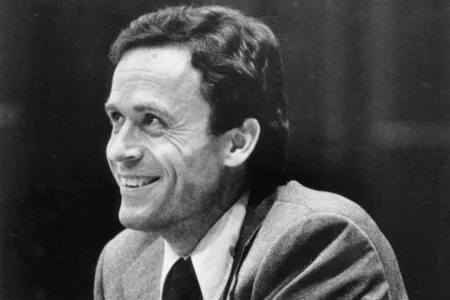
Serial killer Ted Bundy is linked to another Utah teenager's 1974 killing through DNA testing
DNA connects serial killer Ted Bundy to the death of another Utah teenager, authorities announced Tuesday, exactly 52 years after her body was discovered in the woods by a hunter.
Bundy has been dead since 1989, but the tally of his confirmed victims continues to grow due to advances in DNA testing. He killed at least 30 women and girls in multiple states in the 1970s, and many more escaped or survived with injuries.
Investigators are satisfied that Bundy was responsible for killing 17-year-old Melissa Ann Smith in 1974, a death that had long been listed as a cold case, Summit County Attorney Margaret Olson said at a news conference.
They were able to close the case by making crucial connections with DNA found on Smith and Laura Aime, another Bundy victim whose case was resolved last April in Utah County. Bundy's DNA was on file in Florida, where he was convicted and ultimately executed.
Besides that evidence, Smith's death showed hallmarks of Bundy's "pattern, motive, means and opportunity," Olson said.
Utah's state crime lab got new technology in 2023 that extracts DNA from samples even if they are small, degraded from age or contain DNA from multiple people.
"This case demonstrates the importance of preserving evidence," said Salt Lake County Sheriff Rosie Rivera, whose department has also investigated homicides linked to Bundy.
"We have to solve these cases to the best of our ability," she said, explaining the importance of tapping science, even so many years later. "Nobody is just going to walk away and just blame everything on Ted Bundy, even though many cases have been that way. Here in the state of Utah, we take it very seriously."
Smith's relatives were contacted about the findings but declined to attend the news conference and declined to speak to reporters, the Summit County Sheriff's Office said. Her parents are deceased.
Smith's father was police chief in Midvale, south of Salt Lake City. She was at a pizza parlor and a restaurant before she disappeared on Oct. 18, 1974, The Salt Lake Tribune reported at the time. Nine days later, her body was found in Summit County.
"With every case closure, may we stomp the memory of Ted Bundy out," Utah County Sgt. Mike Reynolds said.
Lawsuit seeks to block ICE from hiding locations of detainees with final removal orders
Groups that provide legal services to immigrants filed a lawsuit Wednesday seeking to stop the Trump administration's new policy of hiding the locations of tens of thousands of detainees with final deportation orders.
The policy, adopted suddenly last month to expedite deportations, interferes with immigration lawyers' rights by making it difficult, and sometimes impossible, to locate their clients, according to the lawsuit filed in federal court in Boston. It asks a judge to issue an order blocking the "unlawful and inhumane" change.
"No one should be denied a meaningful opportunity to defend their rights because the government has made it impossible for their lawyer to find them," said Jacquelynne Bowman, executive director of Greater Boston Legal Services, one of the four groups listed as plaintiffs. "This arbitrary new administrative change leaves hundreds of thousands of people at risk of potentially life-altering consequences without essential legal help."
The lawsuit challenges U.S. Immigration and Customs Enforcement's decision, first reported by The Associated Press, to remove the locations of people facing final removal orders from its Online Detainee Locator System and to instruct staff not to reveal their whereabouts. As of last month, the move affected more than 16,000 of the nearly 69,000 detainees who were in ICE custody.
ICE and its parent agency, the Department of Homeland Security, have not publicly confirmed the change but have said they are prioritizing people with final removal orders for deportation. They have also said they are facing a "historic number of injunctions" from courts blocking their efforts. The agencies have denied that they are disappearing detainees, saying they remain free to make phone calls.
"Illegal aliens in detention have several ways to communicate with their family members and lawyers," DHS said in a statement responding to the lawsuit. "The appropriate process due to an illegal alien with final deportation orders is removal, plain and simple."
Since 2010, lawyers and family members have used ICE's online system to track detainees as they get moved from facility to facility through ICE's sprawling detention network.
Alvin K. Hellerstein, a federal judge who handled Trump, Maduro and 9/11 cases, dies at 92
NEW YORK (AP) -- Alvin K. Hellerstein, a Manhattan federal judge who presided over cases involving President Donald Trump, former Venezuelan President Nicolás Maduro and the 9/11 attacks during nearly three decades on the bench, has died. He was 92.
Hellerstein died Wednesday morning while surrounded by his family, Chief Judge Laura Taylor Swain said in a statement. His funeral is scheduled for Thursday at Riverside Memorial Chapel in Manhattan.
Swain remembered Hellerstein as a "distinguished jurist" and praised his "energetic and dedicated service" to the court, which continued until his death.
"He is greatly appreciated and will be sorely missed," she said.
Just two weeks ago, Hellerstein presided over the arraignment of Maduro and Maduro's wife, Cilia Flores, on torture charges that were added to their ongoing narco-terrorism conspiracy case.
Maduro, who was captured alongside his wife in January in a surprise U.S. military raid in Caracas, twice defied Hellerstein's request to enter a plea. Irked, Hellerstein took matters into his own hands, interjecting that "a plea of not guilty will be entered on behalf of Mr. Maduro."
At Flores' Oct. 8 bail hearing, Hellerstein coughed and struggled to speak at times, telling lawyers: "I have a voice problem. As long as you can understand -- hear me, I'll keep going." Nevertheless, he was resolute that he'd preside over Maduro and Flores' trial, which he'd scheduled for next June.
"We were saddened to learn of Judge Hellerstein's passing and offer our condolences to his family," Maduro's lawyer, Barry Pollack, said.
Analisa Torres, the judge taking over the case, was part of an international monitoring delegation for Venezuela's 2006 presidential election, won by Maduro's late mentor and predecessor Hugo Chávez. A federal judge since 2013, she previously served on the state bench in Manhattan.
A New York native and Columbia Law School graduate, Hellerstein served in the U.S. Army Judge Advocate General's Corps and worked as a Manhattan litigator before President Bill Clinton appointed him to the federal bench in 1998. He kept a robust docket even after moving to senior status in 2011.
Trump calls for prosecution of Democratic Alaska Senate candidate over spoiler candidate controversy
JUNEAU, Alaska (AP) -- President Donald Trump called for the criminal prosecution of the Democratic candidate running for Senate in Alaska on Wednesday after revelations that her campaign appeared to be involved in recruiting a candidate with the same name as Republican incumbent Dan Sullivan.
The race is among a handful of Senate contests this year expected to determine control of the chamber. Trump had previously directed his Department of Justice to sue to block certification of the Senate race should Democrat Mary Peltola defeat Republican Sen. Dan Sullivan.
"I think they should be prosecuted," the Republican president said about Peltola and the other Sullivan, responding to questions about a report in The New York Times. He earlier had posted on social media that "Peltola should suffer the Legal and Political consequences for what she has done."
The newspaper obtained text messages between members of Peltola's campaign discussing recruiting other people with the same name as the two-term Republican. They eventually landed on a retired schoolteacher in the small fishing community of Petersburg named Dan J. Sullivan. He made it through the state's August open primary and is one of four candidates on the ranked vote ballot for next Tuesday's general election.
Dan J. Sullivan has long denied he was running at Democrats' behest and has said he had no contact with Peltola's campaign: "Zero, none, zilch," he said in June after announcing his run.
He did not respond to a message seeking comment Wednesday from The Associated Press.
Peltola's campaign, in a statement, said: "Mary got in this race because Alaskans deserve a champion who is fighting to lower their costs and put Alaska first, and no tweet or threat from any DC politician will keep her away from that fight."
During a campaign stop in Soldotna, Peltola suggested the Times' report was a "distraction" from issues such as Sen. Sullivan's support of the war in Iran.
"This is just another diversion," she said in a video posted online. "This is all stuff to sell newspapers. This is all stuff to get subscriptions."
New York enacts ban on 'unsafe' chatbot behavior with kids as states push AI regulation boundaries
HARRISBURG, Pa. (AP) -- New York is enacting farther-reaching restrictions on companion chatbot behavior, as states increasingly move to protect children who use artificial intelligence, regulate how employers deploy AI systems and push developers to prevent an AI-caused catastrophe.
Legislation signed Wednesday by Gov. Kathy Hochul outlines a dozen definitions of "unsafe AI companion features" that will be prohibited when a companion chatbot interacts with a child under 18.
A violation could expose a chatbot developer to a lawsuit by the state attorney general's office. Penalties could include monetary damages, shutting down the chatbot and destroying data. The law takes effect Jan. 1.
Hochul, in the thick of her reelection campaign, signed the bill amid growing warnings about the existential risks posed by the rapid development of AI technology and calls for bold action by a reluctant Washington.
With Congress doing little to regulate AI, state legislatures are packed with efforts to wield state consumer protection laws to make AI use more transparent and rein in chatbots and rogue AI frontier models.
New York and California are at the vanguard of such laws that also are targeting social media platforms.
In September, California Gov. Gavin Newsom signed legislation requiring chatbot developers to assess a model's risk to children, show how they tried to eliminate those risks and submit to an independent audit to determine whether they are complying with the law.
He also signed legislation to prohibit social media platforms from deploying addictive features for users under 16.
Meanwhile, eight states sued AI giant OpenAI earlier this month, saying the company's popular chatbot model violated state consumer protection laws by hurting children and deceiving adults in what one activist called "the most significant coordinated state action ever taken against an artificial intelligence company."
However, governors acknowledge that Congress and the federal government have farther-reaching abilities to clamp down on AI-posed threats, even as President Donald Trump has brushed off concerns and warned states not to regulate AI.
Wendy's, struggling with beef prices and growing competition, gets a buyout offer
Wendy's shares jumped more than 14% Wednesday after noted investor Nelson Peltz made an offer to buy the chain, which has been struggling with high beef prices and aging stores.
Peltz's Trian Fund Management and several partners are offering Wendy's $7.35 per share in cash, or a premium of nearly 19% over the stock's closing price on Tuesday, in a deal that would take the company private. The offer values Wendy's at $1.4 billion.
Wendy's, which is based in Dublin, Ohio, confirmed receipt of the unsolicited proposal in a statement Wednesday and said its board has formed an independent committee to evaluate it. At the end of last year, Wendy's had 5,969 restaurants in the U.S. and 1,428 outlets in 38 countries.
Wendy's, founded in 1969 by Dave Thomas and named after his daughter, is known for its square burgers and Frosty desserts. The fast-growing chain introduced the drive-thru window in 1970 and went public in 1976. In the 1980s, as it jockeyed for sales with McDonald's and Burger King, Wendy's launched salad bars and ran its iconic "Where's the beef?" ad campaign.
But as the fast-food market grew even more competitive and rival burger-focused chains like In-N-Out and Five Guys expanded, Wendy's fell behind. Wendy's share of U.S. burger chain sales fell from 11.5% in 2019 to 10.4% last year, according to Technomic, a market research company.
In recent years, inflation has also hurt Wendy's and other U.S. fast-food chains, who have seen traffic from lower-income consumers fall as they raised prices to combat rising labor, food and packaging costs.
Wendy's said Wednesday it is moving "with urgency" to rebuild its menu with a focus on quality and improve marketing and store operations. Wendy's hired Bob Wright, who formerly led Potbelly, as its president and CEO in May. He's the fourth CEO to lead the company since 2024.
Wendy's has been closing outdated U.S. restaurants so it can focus on its more profitable locations. The company closed 240 restaurants in 2024 and said earlier this year that it planned to shutter up to 358 locations in 2026.
Then, last month, one of the largest U.S. franchisees for Wendy's filed for bankruptcy protection after the chain tried to terminate its franchise agreement. Michigan-based Meritage Hospitality Group operates 314 Wendy's restaurants in 15 states.