
Brees overcame size limits to become a HOFer
Trending
NEW ORLEANS (AP) -- The Drew Brees of three decades ago was disinclined to indulge fantasies of becoming a pro football star, believing instead that baseball was the sport he’d play in college.
“Look, I was 6-foot, 170 pounds,” the New Orleans Saints’ career passing leader said in an interview with The Associated Press, recalling his days at Westlake High School in Austin, Texas. “I wasn’t really the prototype of anything in football.”
Although he’d grown up on gridirons as the grandson of an admired Texas high school football coach and won a state championship as Westlake’s quarterback, Brees wasn’t heavily recruited by prominent college football programs in his home state.
This weekend, the 47-year-old Brees enters the Pro Football Hall of Fame in Canton, Ohio, where his bronze bust will effectively become Exhibit A for the triumph of intangibles over measurables.
Whatever Brees lacked in physical stature, he made up for with discipline, intellect, perseverance, instincts and leadership during a 20-year NFL career highlighted by the second-most yards (80,358) and touchdowns (571) passing in league history -- not to mention New Orleans’ only Super Bowl title in the Saints’ six decades of existence.
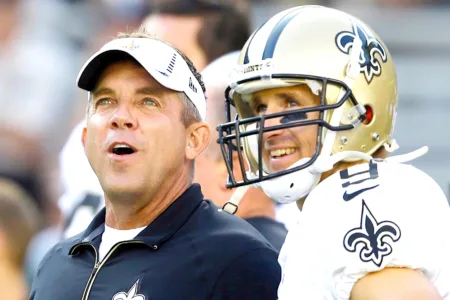
Sean Payton, who coached Brees in New Orleans and now is with Denver, marveled at Brees’ ability to process information quickly, make adjustments at the line of scrimmage and execute.
“He was like A.I.,” said Payton, whom Brees selected as his presenter in Canton. “That ability to process fast -- like, elite fast -- is a really rare gift. He could just multitask comfortably.”
Brees also worked obsessively on throwing mechanics -- even hiring a personal throwing coach -- and it showed in his accuracy and timing. He completed 67.7% of his passes, ranking third all-time -- first among QBs with more than six NFL seasons. His single-season completion rates of 74.4% in 2018 and 74.3% in 2019 are the top two in NFL history.
Living by a maxim that equated failure with opportunity, Brees exhibited a knack for turning tribulation into triumph. His 53 game-winning drives rank third (tied with Ben Roethlisberger) and behind just Tom Brady (58) and Peyton Manning (54).
Brees retired after the 2020 season. Several years before that, players, coaches and executives around the NFL were already referring to him as a Hall of Famer.
“We all just expected he was going to go in in five years -- first ballot, no questions asked,” said Saints general manager Mickey Loomis, whose tenure in New Orleans spanned all of Brees’ 15 seasons with the club. “It’s not a surprise.”
The symmetry of Hurricane Katrina-ravaged New Orleans being the place where Brees bounced back from a career-threatening injury to his throwing shoulder provided yet another layer to the quarterback’s story.
“How I ended up in New Orleans was just such an unlikely scenario,” Brees recalled. “And yet, it could not have been more perfect.”
The pinnacle was Brees’ Super Bowl MVP performance against Indianapolis in February 2010 in Miami, marked by his second-half passing numbers of 19 completions on 20 attempts for 151 yards and two TDs. The postgame image of Brees holding his then-1-year-old first child, Baylen, as both grasped at fluttering confetti, is iconic in New Orleans.
Back in the Big Easy, that victory ignited cathartic, rapturous celebrations and set the stage for a victory parade as wild and well-attended as any held during Mardi Gras.
The Saints made the playoffs in nine of Brees’ 15 seasons in New Orleans. Since then, the club has gone 36-49 under three coaches without a postseason appearance.
ALL-AROUND ATHLETE
Brees credits his athletic success to a childhood spent pursuing numerous sports, including baseball, basketball, soccer, tennis and cross country.
By high school, Brees saw himself as a potential prospect at shortstop or third base who could hit for average and power from the left side. The athlete he most admired was Boston Red Sox Hall of Famer Ted Williams, the inspiration behind Brees wearing the No. 9 throughout his NFL career.
When Brees tore knee ligaments during a high school football playoff game his junior season, he worried most about how missing baseball the following spring might jeopardize his scholarship prospects.
Baseball “is what I was hoping would be my path,” Brees recalled, adding that he was not bitter about not receiving football scholarship offers from Texas, where his uncle, Marty Akins, played quarterback, or Texas A&M, where his parents went to college.
None of the major football programs in Texas offered him one.
“I get it,” Brees said. “We won a state championship. I was 5A state offensive player of the year. But, I didn’t have a lot of the measurables.”
But Brees got an offer from then-Purdue coach Joe Tiller, who ran a pass-heavy spread offense. Intrigued, Brees accepted, moving about 1,100 miles from home to continue playing football.