

Trending
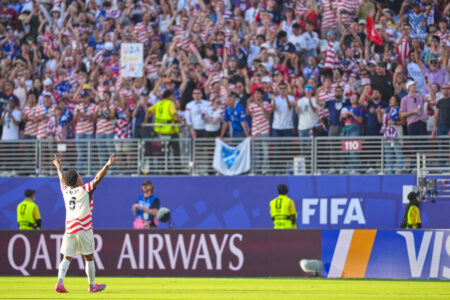
United States’ Auston Trusty (6) gestures to supporters following the World Cup round of 32 soccer match between the United States and Bosnia in Santa Clara, Calif., near San Francisco, Wednesday. (AP Photo/Julio Cortez)
For 160 of this country’s 250 years, soccer, under rules we would mostly recognize today, has been played here.
It’s hard to fathom in a sense because the sport has often struggled to gain broad acceptance.
Following the USA’s gutsy 2-0 win over Bosnia and Herzegovina on Wednesday in the World Cup round of 32, the country once again finds itself in a place where it can lean in and really start to process how far the game has come.
For years the bet was always on “a big star” or “big moment” that would break the game free to join the ranks of football, baseball and basketball. It did not work in the way it was designed with Pele in the old North American Soccer League in the 1970s. It didn’t work when David Beckham was brought in to join Major League Soccer’s Los Angeles Galaxy. And while Lionel Messi still is one of the best if not the best in the world his presence in Miami has done little more than provide some nifty highlights and increased jersey sales.
It was never going to be one guy. It was never going to be one story. It was never going to be one tournament result.
In the 32 years since the United States last hosted the men’s World Cup, it has been a steady climb but maybe not always linear. The MLS has emerged and managed to stay in business. The United Soccer League, in which the Pittsburgh Riverhounds are a member, has brought fun to cities that maybe aren’t as big as the ones represented in MLS. The U.S. women’s team has won four World Cups and pushed the needle in their own way. Networks such as ESPN, CBS, Fox and NBC have invested in televising live games here and abroad at all hours of the day. Exhibition games featuring any foreign power you could imagine often play here in the summer months.
But there has always been something missing because we have never quite been able to attach a sense of our own identity to it. A lot of the times, it’s borrowed traditions that dominate and a lot of times that’s a barrier that’s too high to clear for the casual sports fan.
It seems as if this men’s team is trying to change that. The Argentine coach of the U.S. team Mauricio Pochettino has made it clear that he wants this team to play as Americans. He listens to country music and makes the staff do so. He makes it a point that the team understands how U.S. teams of other sports have done great things. He has stated he has fallen in love with the “Miracle on Ice” story and has said he wants that as a template to play the right way as an American. In victories he is out there leading the singing of “Country Roads” which is something that Americans familiar with college traditions can get into.
The 4-1 win over Paraguay to open the tournament lit up social media and in turn has opened people up to the traditions of other nations. Scotland’s Tartan Army was a big hit in the Boston corridor and beyond. People are also transfixed with the Norway viking row, so much so that you have American firefighters and people in board rooms trying it out for kicks. Of course, it also helped that the Americans were playing the kind of attractive soccer that is easy on the eyes instead of the more reserved, defensive mindsets of the past.
There was a lot of talk at the beginning of the tournament that the stadiums wouldn’t be full because of the expensive ticket prices. You’d like that to be true because people already pay enough for tickets for most entertainment options these days. But it was far from true. There indeed was a rabid demand that gave people a very contagious case of ‘fear of missing out.’ FIFA said the tournament was already the most attended in history at the end of the group stages and that 99.7 percent of seats were filled.
If the USA manages to win on Monday in Seattle against Belgium (and that’s a big ask), the drumbeat is only going to grow louder. And much like Lake Placid in 1980, the USA has been successful in leaning in to its home field advantage so far (as has Mexico and Canada who are also hosting the World Cup). Historical trends say teams hosting the World Cup can often outperform expectations. In 2002 South Korea finished fourth when it hosted. Russia made it to the quarterfinals in 2018. This is the time to use that advantage and take it as far as the country roads go.