
‘Riches to Rags’ Part 2
Boom times before the crash
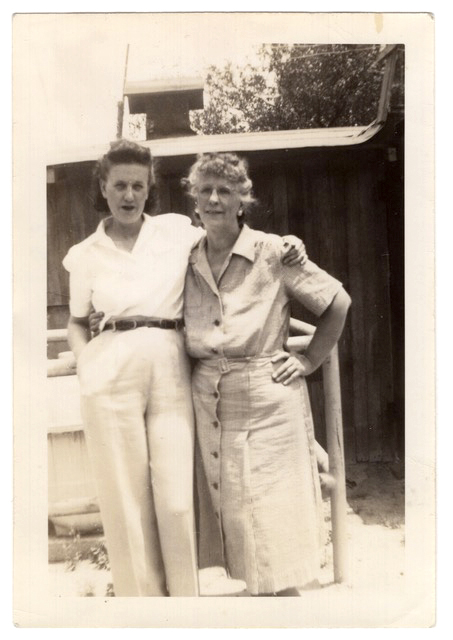
Pearl pictured with daughter Bonnie at the KTK-CA pottery. She lived with Bonnie when her health declined. Pearl died in 1948.
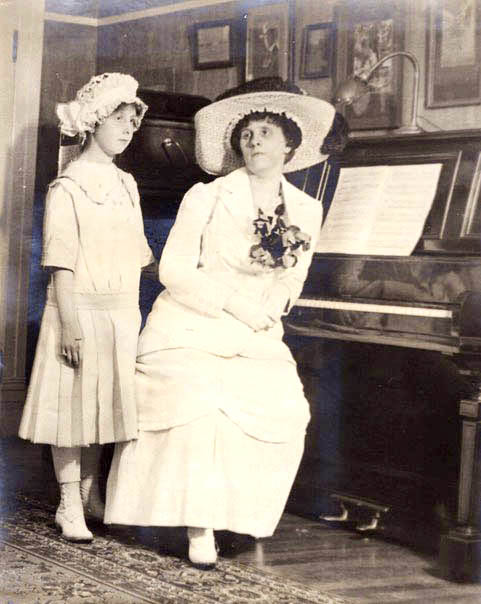
Eileen Taylor and her mother Pearl Sebring Taylor in a 1912 photo taken at their house at 124 W. Fifth St. Homer Taylor was an avid photographer who documented his family in pictures and developed them in a darkroom in that home.
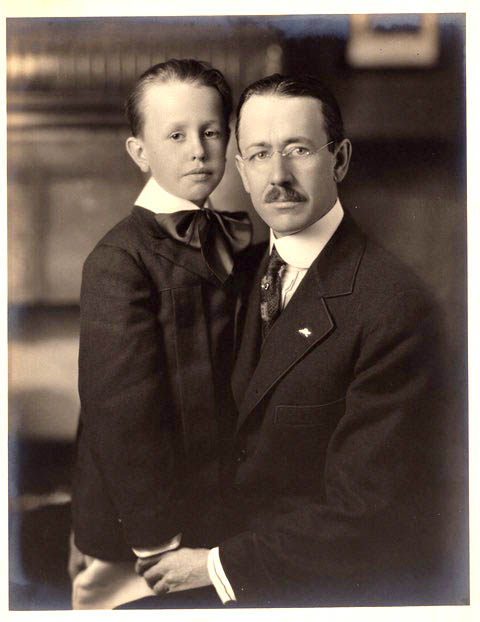
John Oliver Taylor, pictured with his father Homer J. Taylor, was never to find the personal success and happiness of his siblings and cousins, yet remained and worked within the family circle all his life.
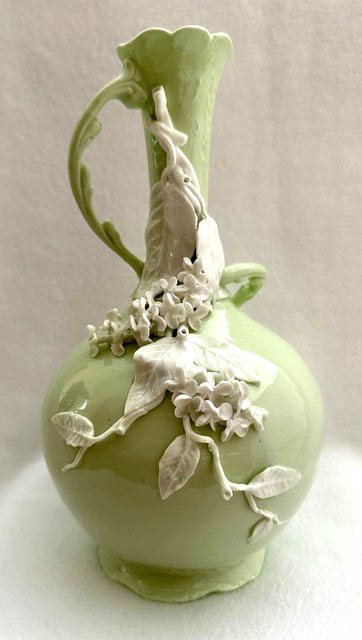
A green “Parmian” vase decorated with applied flowers, stems and leaves by artist Henry Schmidt is an example of KT&K’s delicate, exquisite bone china called Lotus Ware.
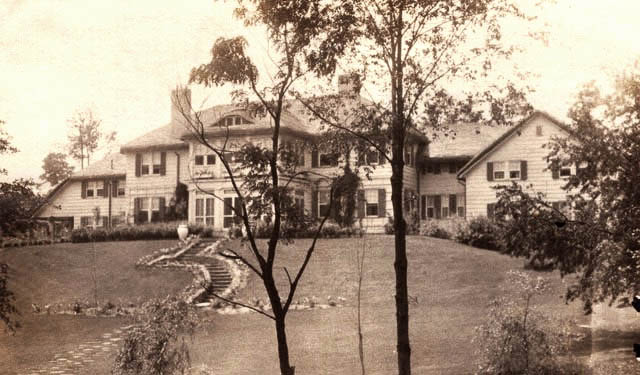
In 1921 Homer and Pearl Taylor built a grand home at the corner of Elysian Way and Park Boulevard. They lost their wealth and the house, sold off furnishings and migrated to California to start a new life. The house burned down around 2002. (Submitted photos)
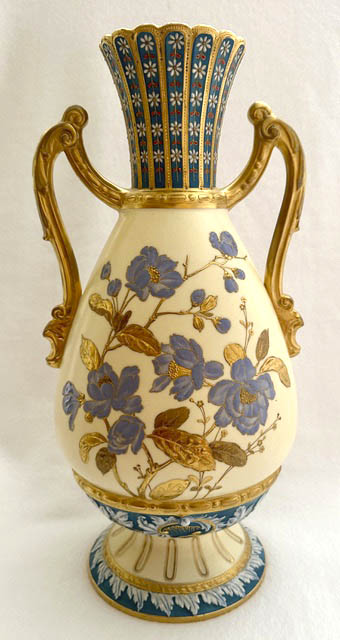
Fifteen inches high, the “Egyptian Vase” was decorated in raised gold and enamel, likely the work of British artist George Morley at KT&K. It was kept when other Taylor family treasures were sold during hard times.
Pearl pictured with daughter Bonnie at the KTK-CA pottery. She lived with Bonnie when her health declined. Pearl died in 1948.
Eileen Taylor and her mother Pearl Sebring Taylor in a 1912 photo taken at their house at 124 W. Fifth St. Homer Taylor was an avid photographer who documented his family in pictures and developed them in a darkroom in that home.
John Oliver Taylor, pictured with his father Homer J. Taylor, was never to find the personal success and happiness of his siblings and cousins, yet remained and worked within the family circle all his life.
A green “Parmian” vase decorated with applied flowers, stems and leaves by artist Henry Schmidt is an example of KT&K’s delicate, exquisite bone china called Lotus Ware.
In 1921 Homer and Pearl Taylor built a grand home at the corner of Elysian Way and Park Boulevard. They lost their wealth and the house, sold off furnishings and migrated to California to start a new life. The house burned down around 2002. (Submitted photos)
Fifteen inches high, the “Egyptian Vase” was decorated in raised gold and enamel, likely the work of British artist George Morley at KT&K. It was kept when other Taylor family treasures were sold during hard times.
Trending
EAST LIVERPOOL – Homer J. Taylor succeeded his father Col. John N. Taylor as president of the giant Knowles, Taylor and Knowles pottery when John died in 1914.
In 1935, long after Homer had lost that position and KT&K went under, when he was ill and his family was scratching out a living in California by hand-making colorful decorative ware in a rented chicken coop, Homer wrote a concise four-paragraph statement explaining the origins of and rationale for making Lotus, KT&K's filigreed, fabulous, fragile art ware.
KT&K had built a new "China Plant" expressly for the production of Lotus Ware, then rebuilt it one year later when destroyed by fire in 1889. Lotus ware vases had won first prize against international competition at the World's Columbian Exposition in Chicago in 1893.
"The firm had long sought to achieve something meritorious in the ceramic arts for the prestige of the American industry," Homer stated. Imported European potters and artisans were given carte blanche to realize that goal, but the prestigious and costly sideline was never in line with KT&K's core business of mass production of durable tableware for the hotel industry. "Its purpose had been accomplished," Homer wrote. In 1896 Lotus Ware production ceased.
Chris Crain found this statement in his files and thought it a bit of a mystery because it was not addressed to anyone. Perhaps near the end of his life Homer felt a need to state clearly the facts about a legacy achievement of KT&K that could never be erased.
A great-grandson of Homer J. and Pearl Sebring Taylor, Crain included Homer's Lotus statement complete in his new book, "From East Liverpool to California: The Riches to Rags Story of the Taylor Family." Discount copies are on sale at the East Liverpool Museum of Ceramics.
The production of Lotus Ware was not the first time the upstart American pottery industry had thumbed its nose at uppity European potters. In the 1870s the Knowles plant had been, along with the Laughlin Brothers, the first potteries to produce white ware here. Homer Laughlin (yes, another "Homer") marked its new white ware with a backstamp showing the American Eagle triumphant over a prostrate British Lion.
Boom times, idyllic lifestyles
Aside from the 1901 assassination of President McKinley, friend and author of protective trade tariffs that fueled the pottery boom, the turn of the century was a glorious time for East Liverpool potteries.
The five brothers who founded the Sebring pottery, George E., Oliver, Ellsworth, Frank and Joseph, were late getting into the potting business (1887) but prospered. In partnership with pottery salesman George Ashbaugh and Staffordshire potter Sampson Turnbull they bought a defunct East Liverpool pottery and made white granite ware, adding three potteries in East Liverpool then leasing a plant in East Palestine, Ohio, in 1893, to found the Ohio China Co. A six-kiln plant was added in East Liverpool's East End, but by 1898 the firm began moving all operations to their new town. (Bill and Donna Gray, Amazing Ware) By 1903, their four plants in Sebring had a workforce of 1,200. (EL Museum of Ceramics)
Both Sebring and KT&K could lay claim in these boom times to being the largest pottery in the country.
The Taylor and Sebring families nurtured friendly connections with families of other East Liverpool pottery entrepreneurs long before the 1901 marriage of Homer J. Taylor and Pearl Sebring. Homer's groomsmen, for instance, were John McDonald, William H. Vodrey, Robert Hall Jr., Fred B. Lawrence, Bert Sebring and Orville Sebring.
In her memoir, Eileen Taylor McNutt (grandmother to "Riches to Rags" author Chris Crain) recalled many Christmases spent with her mother Pearl's family the Sebrings, the children sharing beds and her grandfather O.H. Sebring going overboard with everything. "O.H. always made it more exciting and our mothers were always trying to calm him down, but he paid no attention at all."
In the summer of 1912, Eileen was 11, her brother John Oliver was 7 and Pearl was pregnant with sister Bonnie, so instead of their usual beach trips to resorts in Atlantic City or Miami Beach, Pearl sand Homer took the children camping at nearby scenic Fredericktown, favorite haunt of the Vodreys. Grandmother Belle Taylor's chauffer Stanley left with the car after helping set up rented tents. It rained continually, Eileen was frightened by a snake, and a leach attached itself to a sensitive part of little John's anatomy. "John was so angry and frustrated and dear Daddy went about getting the damnable thing off, and bless him he never laughed once." (Eileen) Homer walked miles of mud roads to the little crossroads settlement at Calcutta and phoned his mother, who arranged for an undertaker to rescue the family in a horse-drawn pallbearer coach.
Pearl Sebring Taylor, college-educated in music, sang frequently at the Methodist Church and sometimes teamed with her sister Anna "Annie," who sang and preached. Annie cajoled her Uncle George Sebring into donating land outside Sebring and piping in city water to create revivalist camp meeting. A tabernacle, dormitory and cottages were built. In September 1912 Evangelist Billy Sunday drew an audience of 6,000, with 650 souls saved. Old Col. John N. Taylor, who attended and afterwards joined the church, was deaf but Homer rigged a transmitter to a telephone at his seat.
Taylor family members and events were recorded in photographs by Homer, an amateur photographer who developed the pictures himself in a darkroom of their second house, a more modest home at 124 W. Fifth St.
A new grand home on Park Blvd.
In the early 1920s the city's wealthy pottery owners escaped the smoke from their Ohio Valley kilns by building sprawling homes in the modern style up St. Clair Avenue, on the hill near the new country club and Thompson Park, donated to the city by "Softly and Tenderly" hymn composer, music publisher and musical instrument entrepreneur Will L. Thompson. Homer and Pearl built their new mansion in 1921 at the most desirable location, the intersection of Park Boulevard and Elysian Way. It had a den five steps below the living room, a woodburning fireplace and another with gas fire logs, open arch doorways, wall to wall carpet on the second floor, a glassed-in sleeping room, cut glass and Persian rugs. The home's eaves turned down to resemble thatched roofs. There was a patio and putting green, a Filipino cook and a butler named Nicholas, and gardener who was the last to be let go when the financial roof fell in 10 years later.
Eileen had been dating a man in the printing business named Harold McNutt. "One afternoon we were just riding around and he asked me to marry him again." The couple dashed across the bridge and got married by a Methodist minister in New Cumberland, W.Va. It was Dec. 30, 1921.
"We all moved into the new big house, Grandmother T(aylor), Harold and I, John, Bonnie, and Mother and Dad. There were eight bedrooms and baths, so it was large enough."
The Depression and 'The Merger'
The pottery business went downhill in the late '20s from foreign competition and other factors. As The Great Depression set in, owners and their families began debating "The Merger," a plan to combine area potteries under one management and sales force, hoping consolidation economies would save them.
"Everyone was sick to death of it, and had discussed it pro and con and from every angle," Eileen recalled. "When talk would simmer down a bit, my grandfather would drive into our town from Sebring and after he had waved his cane around the living room and imbued us with his marvelous enthusiasm, things would be at a fever pitch once more. . . Yes, it was a beautiful idea and like so many other beautiful ideas, it worked in fancy and not in fact."
She later mused, "Maybe it would have been better if we could have gone along in this nice tranquil life of ours, maybe not. I think of all the experiences we would have missed, good and bad, and the thought comes to me of how smug we all might now be if we had continued with that neatly wrapped, safe existence."
As their world crashed around them, the Taylor family called on their faith and pooled their resources in a desperation move to California, land of movie stars and opportunity.
(Third and final in the series:
The crash, then on to California.)