
America at 250: First Transcontinental Railroad had immediate impact on nation that continues to be felt today
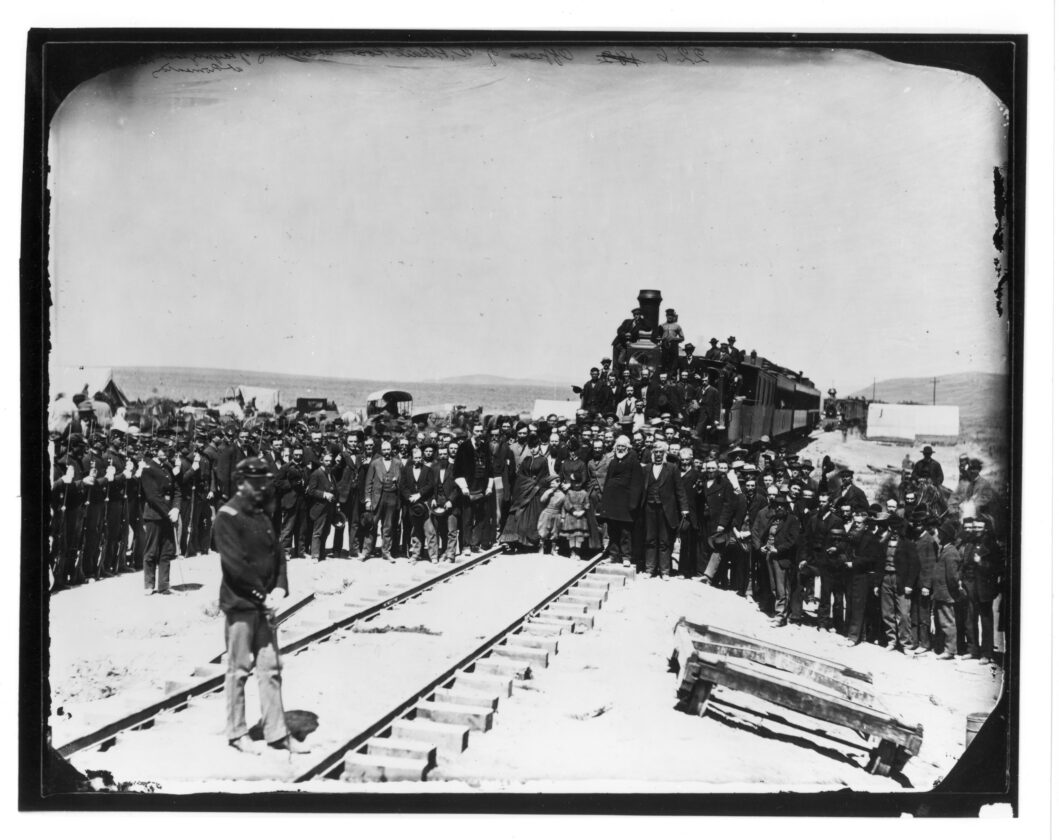
Officers and directors of Union Pacific at the laying of the last rail, Promontory Summit, Utah, May 10, 1869. Image taken by Andrew Russell.
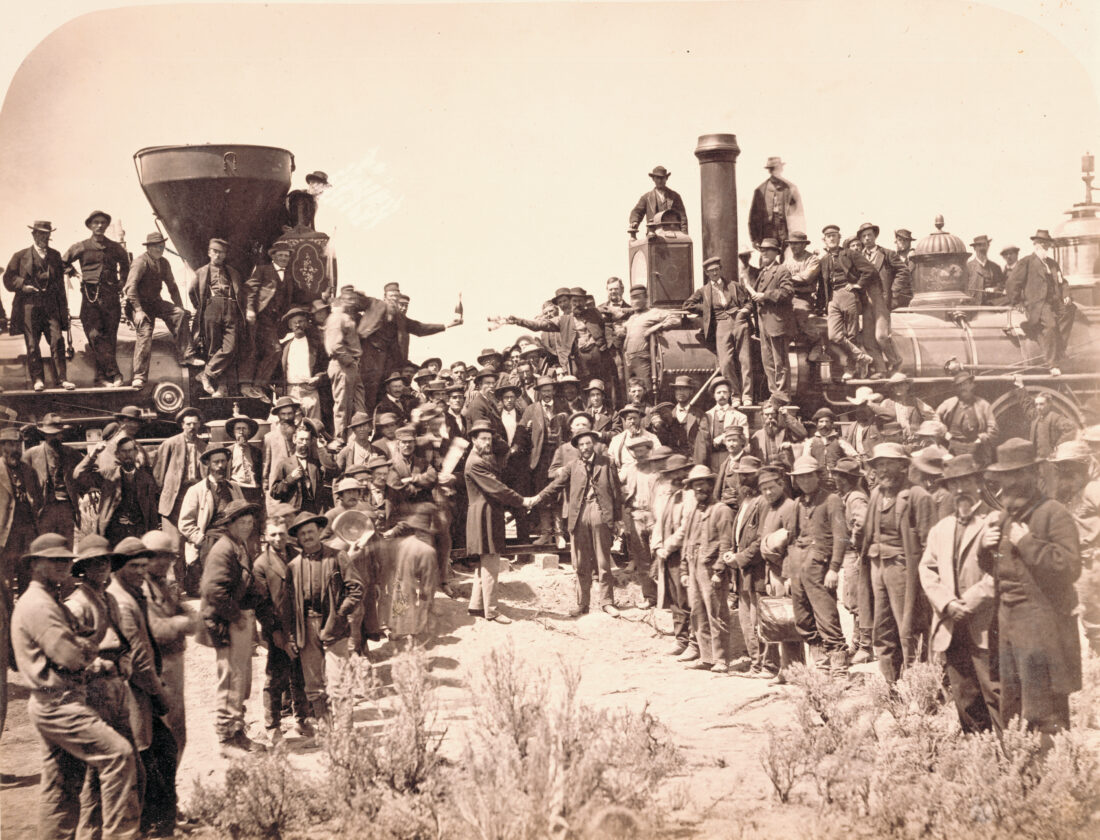
Plate 227, "East and West shaking hands at laying of the last rail," Promontory Summit, Utah. Photograph was taken by Andrew Russell on May 10, 1869. General Dodge, chief engineer for Union Pacific, is pictured shaking hands on the right, with Central Pacific engineer Montague on the left. This print was created before the original glass plate was broken. The glass plate negative is in the collection of the Oakland Museum (California).

Map of the Transcontinental Route from Council Bluffs, Iowa to Sacramento, California, started in 1863 and completed in 1869, through Promontory Summit, Utah. Shows the delineation of Central Pacific Railroad (CP) built line and Union Pacific Railroad (UP) built line.
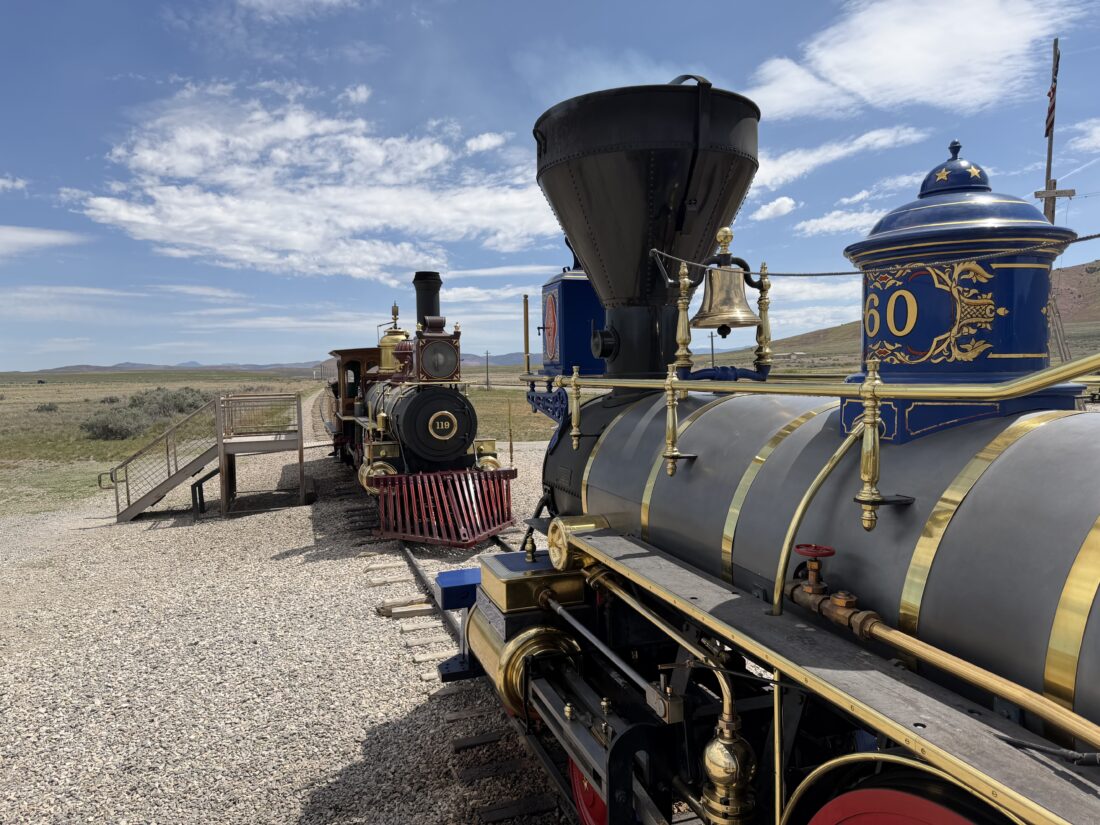
Working replicas of the Central Pacific's "Jupiter" (right) and Union Pacific No. 119 are displayed at Golden Spike National Historical Park on Saturday, May 23, 2026. Rob Nielsen, Standard-Examiner
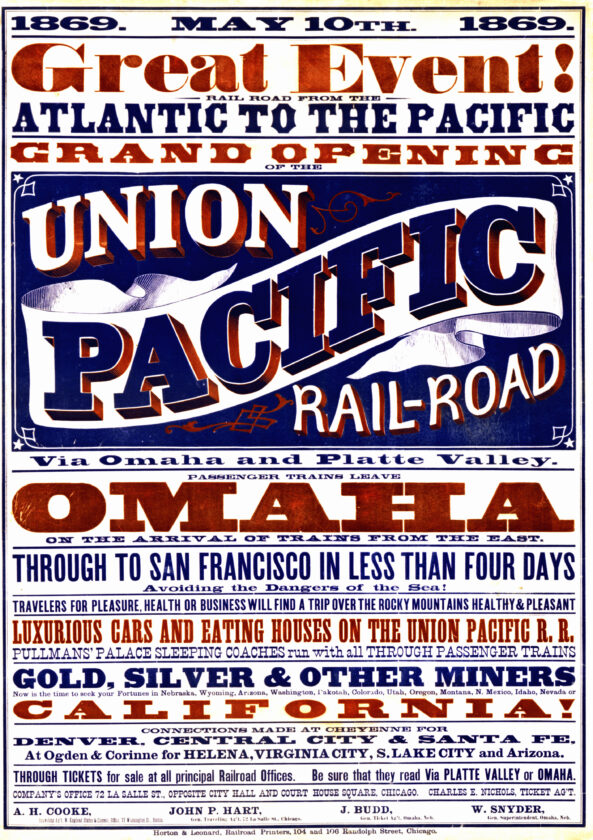
1869 Union Pacific "Great Event" poster highlighting destinations and connections along the new transcontinental route. Produced by Horton and Leonard, Railroad printers, Chicago, Illinois.
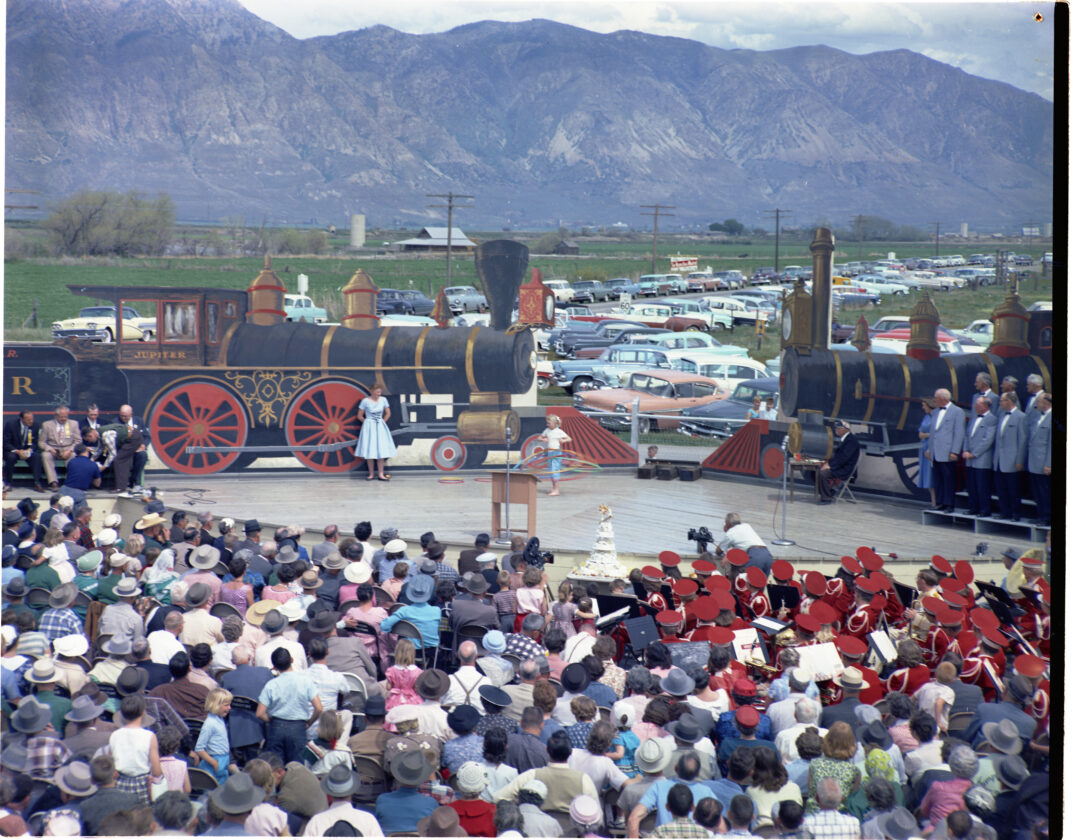
Golden Spike celebration taking place in Corinne, Utah, May 9, 1959. Emulating the infamous meeting at Promontory Summit on May 10, 1869, there are two steam locomotives positioned head-to-head, Central Pacific's Jupiter, and Union Pacific's 119. This celebration was also commemorating the opening of a railroad museum in Corinne with an Oregon Short Line Railroad (eventually Union Pacific) depot building that had been moved from Honeyville, Utah for the museum.
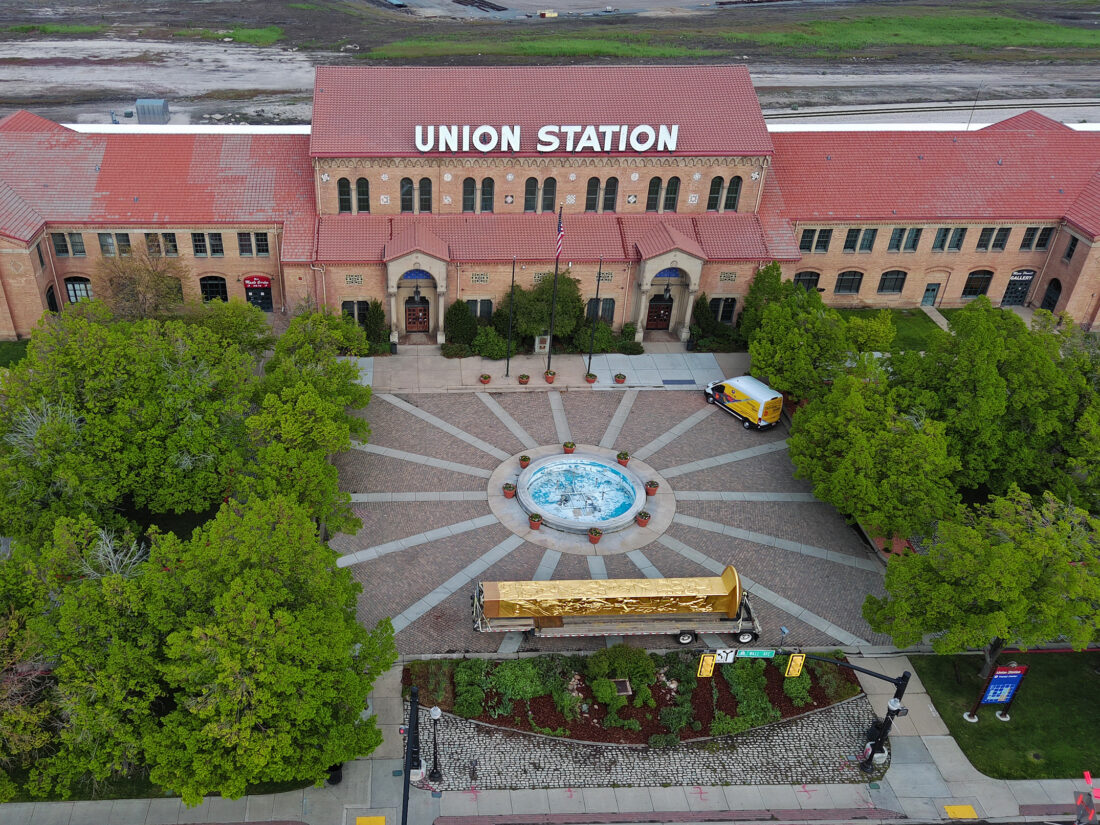
The Golden Spike Monument, a sculpture by artist Douwe Blumberg, was on dispaly in front of Union Station on Friday, May 3. The 43 foot, gold leaf covered monument was commissioned to honor the power and diversity of those who built the transcontinenal railroad. After the ongoing driving tour is completed, the monument will be permananently displayed outside Brigham City beginning in 2025. (DENNIS MONTGOMERY)
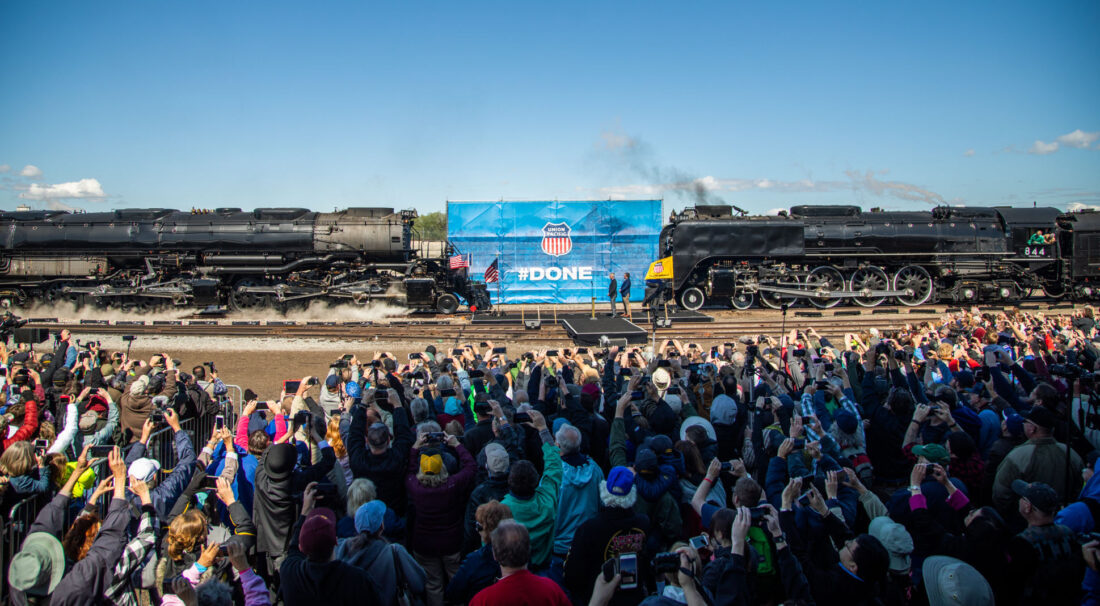
Steam locomotive Big Boy No. 4014 meets head-to-head with Living Legend No. 844 during the ceremonial reenactment of the wedding of the rails on Thursday, May 9, 2019, just south of Union Station as part of the Ogden Heritage Festival to celebrate the 150-year anniversary of the completion of the transcontinental railroad. Ben Dorger, Standard-Examiner file photo
Officers and directors of Union Pacific at the laying of the last rail, Promontory Summit, Utah, May 10, 1869. Image taken by Andrew Russell.
Plate 227, "East and West shaking hands at laying of the last rail," Promontory Summit, Utah. Photograph was taken by Andrew Russell on May 10, 1869. General Dodge, chief engineer for Union Pacific, is pictured shaking hands on the right, with Central Pacific engineer Montague on the left. This print was created before the original glass plate was broken. The glass plate negative is in the collection of the Oakland Museum (California).
Map of the Transcontinental Route from Council Bluffs, Iowa to Sacramento, California, started in 1863 and completed in 1869, through Promontory Summit, Utah. Shows the delineation of Central Pacific Railroad (CP) built line and Union Pacific Railroad (UP) built line.
Working replicas of the Central Pacific's "Jupiter" (right) and Union Pacific No. 119 are displayed at Golden Spike National Historical Park on Saturday, May 23, 2026. Rob Nielsen, Standard-Examiner
1869 Union Pacific "Great Event" poster highlighting destinations and connections along the new transcontinental route. Produced by Horton and Leonard, Railroad printers, Chicago, Illinois.
Golden Spike celebration taking place in Corinne, Utah, May 9, 1959. Emulating the infamous meeting at Promontory Summit on May 10, 1869, there are two steam locomotives positioned head-to-head, Central Pacific's Jupiter, and Union Pacific's 119. This celebration was also commemorating the opening of a railroad museum in Corinne with an Oregon Short Line Railroad (eventually Union Pacific) depot building that had been moved from Honeyville, Utah for the museum.
The Golden Spike Monument, a sculpture by artist Douwe Blumberg, was on dispaly in front of Union Station on Friday, May 3. The 43 foot, gold leaf covered monument was commissioned to honor the power and diversity of those who built the transcontinenal railroad. After the ongoing driving tour is completed, the monument will be permananently displayed outside Brigham City beginning in 2025. (DENNIS MONTGOMERY)
Steam locomotive Big Boy No. 4014 meets head-to-head with Living Legend No. 844 during the ceremonial reenactment of the wedding of the rails on Thursday, May 9, 2019, just south of Union Station as part of the Ogden Heritage Festival to celebrate the 150-year anniversary of the completion of the transcontinental railroad. Ben Dorger, Standard-Examiner file photo
Trending
It’s very rare that we can say a nation was fundamentally different the day after a major construction project was completed from what it was the day before.
But that’s exactly what happened to the United States of America on May 10, 1869, as the First Transcontinental Railroad was declared complete in a far flung corner of the Utah Territory.
Trips that previously had been measured in months could now be completed in days. Goods that would be a rarity on one side of the country could now be consumed on either coast. People on one coast could now reliably communicate with the other.
The new rail line gave people who had only dreamed of owning land an opportunity to do so while simultaneously leading to many being forced from the lands they had called home for centuries. Its construction would also go on to heavily influence railroad building across the country and around the world.
And while the machines that have plied it, the railroads that made it up, the routing and technologies surrounding it have evolved in ways its builders never could’ve imagined, the First Transcontinental Railroad still serves the country as it celebrates the 250th anniversary of its independence.
Recently, the Standard-Examiner spoke with Union Pacific Railroad Museum curator Patricia LaBounty and explored the Golden Spike National Historic Park to learn a bit more about this achievement that continues to help bind a nation together.
A Rebuilding Nation
Construction of the First Transcontinental Railroad took place amidst the backdrop of the most tumultuous decade in the country’s existence.
The Civil War had lasted from 1861-65 and would be immediately followed by a tense period of Reconstruction.
Union Pacific Railroad Museum curator Patricia LaBounty noted that the project’s origins came right in the middle of the war.
“The Civil War divided families,” she said. “It certainly divided neighbors and it was a huge economic and social impact to the nation as a whole. While that was going on, right, you had the Homestead Act (1862) signed the same year that the Pacific Railway Act was signed. And in many ways, those two pieces of legislation are intertwined. In the Pacific Railway Act, you have alternating one-mile sections of land that were provided to the railroad on either side of the track to sell, as part of the vehicle by which the railroads could pay for this endeavor. And the reason they were alternating is that the government retained the intervening miles. Those would then be eligible for homesteading. So at the same time, you have this conflict going on in the Civil War. You have people from around the world, especially from Northern Europe, Ireland, looking to find some opportunity, a better life, something that looked like it might be a positive future experience at the same time the Civil War was going on.”
The Central Pacific Railroad broke ground at Sacramento in 1863 while the Union Pacific Railroad broke ground at Omaha, Nebraska Territory -- just across the Missouri River from its terminus of Council Bluffs, Iowa -- the same year.
LaBounty said that as construction of the route ramped up post-war and closed in on completion, the nation saw it as a hopeful sign in the fragile peace that had set in.
“By the time we get to 1868-69, Reconstruction had begun in the South,” she said. “It was rocky. Lincoln was assassinated in 1865. And I think that at that time in the national sort of public opinion area, this construction project, the feat of engineering, the reliance on immigrant labor, was a win for the country. It felt like a positive note in the midst of this very challenging decade that the United States was undergoing.”
May 10, 1869
On July 3, 1776, John Adams penned a letter to his wife Abigail in the wake of the Continental Congress declaring independence from Great Britain the day before.
“The Second Day of July 1776, will be the most memorable Epocha, in the History of America,” Adams declared. “I am apt to believe that it will be celebrated, by succeeding Generations, as the great anniversary Festival.”
However, it would be the Continental Congress’ acceptance of the Declaration of Independence on July 4, 1776, that would go on to be the date celebrated as the great anniversary festival.
It’s almost fitting that a hair under 93 years later, the completion of the country’s greatest industrial feat to date would be celebrated at Promontory Summit a full two days late.
“May 10 wasn’t supposed to be the day," she said. “It was supposed to be May 8. In fact, the original gold spike presented by California says ‘May 8th’ on it. As with any great project, there are last minute alterations to schedule.”
LaBounty said, despite the delay, there was plenty of celebration to be had.
"There was a program of some speeches,” she said. "There was a prayer. There was a last spike ceremony where Leland Stanford, president of Central Pacific and Thomas Durant, vice-president of Union Pacific, were to take turns hammering in the final spike. And of course, these people had never handled a spike maul in their lives. It didn’t go as well as imagined, and jokes were made on site.”
During the ceremony, four ceremonial spikes were presented -- a gold “Last Spike” from California, a silver spike presented by Nevada Territory, a second gold spike presented by the San Francisco News-Letter and an iron-silver-gold spike presented by the Arizona Territory.
The Arizona Territory may seem like an odd addition, given the First Transcontinental Railroad doesn’t even come close to its borders.
But LaBounty said it was presented to send a not-so-subtle message.
“Basically, it’s, ‘Hey, come do us next -- please build the southern route,'” she said.
The Arizona Territory would eventually get its wish, being officially connected into the national rail network in 1881.
A display at the Golden Spike National Historic Park notes that the “Last Spike” and Nevada Spike are in the possession of the Stanford University Museum, the Arizona Spike is currently in possession of the City of New York while the whereabouts of the second golden spike are unknown.
LaBounty described the ceremony itself as a chaotic day.
“There were hundreds of people there,” she said. “There was a unit of Buffalo Soldiers who were going through that area to somewhere else that happened to be there. There was a military band. There were hundreds of people who just wanted to check it out. Grenville Dodge had his 14-year-old daughter Lettie with him there. There were women and children present at this ceremony, and you can see them reflected in the photo archive of the day. There were three photographers present that day -- Alfred Hart, who was photographing for Central Pacific, Andrew Russell, who was photographing for Union Pacific and Charles Savage, who was a Salt Lake photographer that came up for the day to take some photographs of what was going on. So it’s well documented, at least in photography.”
She said that historians have debated the exact timing of photographs for years, with some being taken on May 9 and some being taken May 11.
But one thing is certain about the photograph that didn’t survive.
"The actual photograph that was supposed to show the two executives swinging the spike maul to hammer in that final spike, the negative broke on site,” she said. “And so that photograph was lost forever.”
She said an unlikely, informal photograph emerged to celebrate the moment.
"The East-West photograph with the two locomotives and the two gentlemen shaking hands -- those were the chief engineers for the project. And they wanted to have a photo of the guys who did the work. So it’s the locomotive crews, it’s some of the foremen for construction and it’s the two chief engineers. And that becomes our iconic photograph, when it really was just supposed to be an informal one of the many of that day and the final spike ceremony was supposed to be the big moment. But that’s what happens when you photograph with glass plates.”
At 12:47 p.m., a telegram went out to the nation with a single word -- “DONE.”
The country changed almost that instant.
Instant Impact
With Council Bluffs connected into the national rail network by the Chicago & Northwestern Railroad in 1867 and easy river transportation between Sacramento and the San Francisco Bay Area, a person could now travel from one coast of the country to another nearly interrupted.
LaBounty said, with the Union Pacific and Central Pacific having already been in operation before the route’s completion and people already beginning to buy the plots of land along the railroad, it took no time at all for its impacts to be felt.
“You think about what travel from New York to San Francisco would have been like previous to 1869,” she said. “It could be six to eight months of travel, whether you went by ship or you went by wagon from the Missouri River West. It was dangerous. … In fact, Central Pacific’s first chief engineer, Theodore Judah, died of yellow fever after crossing the isthmus of Panama, which was one option when you were trying to get from California to Washington, D.C.”
She said it wasn’t just travel times being cut down -- a whole new vision of commerce was now open to Americans coast-to-coast.
“One of the first shipments across the Transcontinental Railroad was tea from Japan,” she said. “So suddenly we’re opening up this international global economy and commerce, but also having a direct impact culturally and socially on what people were actually eating at their dinner tables. It changed how we thought about agriculture. This was the beginning of the establishment of the bread basket and the citrus produce areas of California and Florida. So suddenly I could have oranges in Nebraska or in Washington State or Chicago quickly and easily using this Transcontinental Railroad network.”
LaBounty added that communication became infinitely more reliable.
“The Transcontinental Telegraph network aligned with the railroad tracks,” she said. "Suddenly information could be sent coast-to-coast immediately as opposed to waiting for the Pony Express or waiting for a telegram that you hope made it through and wasn’t disrupted somewhere along the way.”
But while the First Transcontinental Railroad brought a sense of unity and opportunity to many across the country, it did not benefit everyone.
The American West was not completely devoid of people and cultures before the First Transcontinental Railroad. Prior to its arrival, dozens of indigenous cultures had called the land that would one day be traversed by the railroad home for thousands of years.
A display at the Golden Spike National Historical Park notes that the railroad was built through the lands of 15 tribal nations. Treaties were negotiated with some. However, in other areas, the railroad was built without regard to the original inhabitants.
A Continued Impact
LaBounty noted that President Abraham Lincoln saw a vision for the First Transcontinental Railroad.
“Lincoln talked about the railroad … binding the nation together -- not just North and South, but also East and West,” she said. “And that this was an important physical manifestation of that binding.”
In this, the First Transcontinental Railroad was successful. While it disrupted the country -- in both positive and negative ways -- there can be little doubt of its impact on the nation.
Just minutes away from Promontory Summit -- where in 1869 the steam locomotive and telegraph marked some of the highest technology of the day as East met West -- is Northrop Grumman’s Promontory facility which has produced rocket fuel for America’s space program for several years. In 2023, Union Pacific transported 10 rocket motors produced at Promontory for the Artemis II mission which, earlier this year, took four astronauts on the first crewed flight around the moon since 1972. In doing so, these vital components traversed parts of the route of the First Transcontinental Railroad on their journey to Florida.
“When you think about all of those things that define the moment in 1869 -- connection, connecting communities, communication -- all of those things are still true with the railroad ... network that we have today,” LaBounty said. “These corridors of connection between American communities and between the world are as applicable today as they were in 1869.”
For The First Transcontinental Railroad, the word “DONE” was only the beginning.