
Proactive policing at forefront in Chester
Trending
CHESTER, W.Va. -- The city's new police chief credits strong partnerships among law enforcement efforts across the Ohio River for keeping city residents safe.
During a weekend ride-along, Police Chief Chuck Stanley, one of his full-time patrolman, Tyler Campbell; a Hancock County sheriff's deputy and West Virginia State Police kept busy on the streets and parking lots in downtown Chester.
Stanley called the "manpower" not typical necessarily among most departments. But it did reflect the close relationship with Chester police, the Hancock County Sheriff's Office, which is now operated by former colleagues Scott Gittings and Todd Murray; and even the West Virginia State Police, which also had two of their four troopers up from their New Cumberland barracks.
Chester officers keep busy not only with their own calls but are quick to assist other agencies when backup is needed.
Chief Stanley said his full-time patrolmen typically work 80 hours as most individuals do over two weeks. However, it isn't five days a week like most folks. A typical Chester patrolman works three 12-hour shifts during the first week and four 12-hours shifts the second week.
Police chief Chuck Stanley explained that it allows his officers to get nine days off in a row, which has proven to be good for morale.
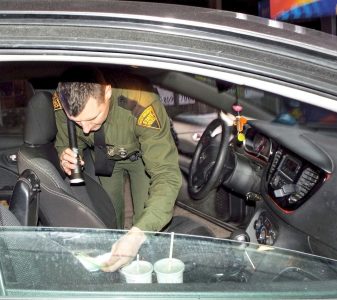
While most of their traffic stops may end in verbal warnings, law enforcement often does seize the opportunity associated with the contact to garner consent searches for drugs -- especially if the person may be associated with known drug users or past criminal offenders.
While Campbell answered calls and backed up the other two agencies in Chester, Chief Stanley also did his part by patrolling the neighborhoods. Citizens almost seemed comforted by his presence, often emerging from their garages and front yards as he passed by to share any kind of area concerns for him to follow up.
Whether concerned about after-hours traffic at the city's skate park or a nighttime check of the city's overlook -- where folks enjoyed some late night-fishing -- Chief Stanley's presence created a more proactive approach to their jobs instead of the reactive one that often is a necessity when departments find themselves understaffed.
According to Chief Stanley, his department employs five full-time and five part-time patrolmen. The typical starting wage for a new uncertified full-time officer is $33,000 plus benefits and $37,000 for a first-year certified officer.
With three-plus months under his belt at the helm in Chester, Chief Stanley appears very happy with the staff that he inherited from Murray, the city's former police chief who now serves as Hancock County chief deputy to Gittings.
"Our guys are all very gung ho," Stanley said, adding he allows them to use their instincts when doing their jobs and hasn't been disappointed.
Stanley is a former K9 handler in the public and private sectors.
While Chester does not have a canine unit, the city does have access through its county relationship, he said.
This post-pandemic Chester is a lot different than the one he remembered before 2021. "We used to have eight bars on Route 30 within a three-mile stretch, but that slowed down with COVID," Stanley said, adding that he enjoys the tranquility associated with just driving around and helping people.
West Virginia does differ in its treatment of bars compared to Ohio. While it is common for many Ohio police officers to do walkthroughs of alcohol establishments on a Saturday night, on-duty police officers cannot just walk into bars in West Virginia. "They are considered private clubs," Stanley said.
In addition, while the legal alcohol limit for a person more than 21 years of age is .07 in Ohio, the threshold in West Virginia is slightly more. A subject 21 years of age or older who has a Blood Alcohol Concentration (BAC) of .08 is legally drunk in West Virginia.
Last Saturday night, many of the law enforcement encounters resulted from routine traffic stops. Whether speeding on that hilly stretch of highway while entering West Virginia from East Liverpool or equipment violations. More times than not a verbal warning was enough to get the attention of motorists.
Stanley explained that most fatalities occur on Route 30 after just entering the state from the Jennings Randolph Bridge. So his officers spend a lot of time there.
There also were the periodic stops, where the driver might just need assistance either turning his headlights on or getting used to driving a stick shift.
Chester does have its challenges like every department. While most of the southern Columbiana County departments took advantage of its COVID money to replace cruisers, radios and body cameras, Chief Stanley said that his city needs to replace two cruisers this year.
He drives one from 2009 and Campbell is operating a 14-year-old cruiser himself.
While the city has the funds for one, replacement of the second car will fall to donors like the Chester Veterans of Foreign Wars and American Legion, which have assisted with replacement of the city's last two cruisers, Stanley said.
So, on a typical day, travelers of Chester roads would see a highly-visible police presence. But it wouldn't be out of the ordinary to see county and state law enforcement conducting traffic stops.
After all, as Stanley points out, Hancock County sheriff deputies have jurisdiction on traffic and criminal calls anywhere throughout the county and the same applies for the West Virginia State Police throughout the state.