
Trending
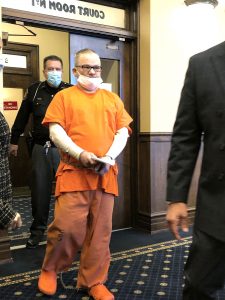
LISBON -- David M. Shafer was sentenced to 14 years in prison in Common Pleas Court Friday on charges related to the death of his father, Delbert Shafer, early in 2018.
Shafer, 51, state Route 558, Leetonia, told Judge Megan Bickerton, "My father Delbert was an awesome person. He had a wicked sense of humor. He was super smart. He loved to hunt. He loved to fish. He loved just being outside. Everything he was is who I am today. I never loved anyone more or anything more than I loved my father."
Shafer claimed he feels his father's pain and the pain of losing his father everyday, when he falls asleep and when he wakes up.
"I'm not an angry man," Shafer said. "I'm not a violent man. What happened is a terrible, tragic and awful accident and I just ask for mercy and understanding."
Newly appointed Chief Assistant County Prosecutor Ryan Weikart requested the 14-year sentence -- eight years for the voluntary manslaughter charge and two years each for charges of having weapons while under a disability and tampering with evidence.
Weikart said Delbert Shafer had died after being beaten by his son, who then allowed him to die from his injuries instead of seeking medical care for him. David Shafer then cleaned up the homicide scene, lied to investigators and gave some of his father's guns, the ones of less value, to his 18-year-old half-brother.
Additionally, Weikart said the elder Shafer had taken his son in when he did not have a place to stay while he was on parole in Pennsylvania. Shafer had been previously convicted in Pennsylvania, where he had faced 13 counts of burglary, nine counts attempted burglary and 11 counts receiving stolen property, as well as some theft offenses.
There was a secret room where many of the guns were hidden and deputies knew Delbert Shafer had guns. A table, a stack of books and other items were used to conceal that room from law enforcement the second time they came into house with a search warrant.
While David Shafer may have implied or indicated some provocation, Weikart asked Bickerton to look at the age difference and physical difference of the two men.
"Basically, you have a situation where the defendant beat his father to death with his bare hands," Weikart said.
Deborah Williamson, Delbert Shafer's ex-wife who was the stepmother to David Shafer starting when he was about 10 years old, spoke prior to sentencing. She told Bickerton that Delbert Shafer was always helping his son out whenever he got into trouble or needed money. She called the defendant "manipulative and defiant" even as a child and claimed he had threatened her before.
Williamson questioned what kind of a man beats his own elderly father to death and noted she had read the death certificate, which said the approximate time between the injuries and time of death was hours.
"It was a brutal death where the victim suffered greatly. No one deserves to die that way," Williamson said. "As much as he and I didn't get along at times, I was devastated when I heard."
One of Shafer's three defense attorneys, Jennifer Gorby, contended that most teenage boys are difficult to deal with and Williamson had gathered a lot of the information she said second hand, from other family members in a family where there were strained relationships.
According to Gorby, Shafer had been living in his father's home here while his father had been staying with a woman in Trumbull County. The elder Shafer moved back after that relationship ended. Additionally, Gorby said the firearms belonged to the father and her client did not use them. As far as giving the guns to his 18-year-old half-brother, Gorby said that it is normal for a family to split up the belongings of someone who died.
Additionally, Gorby said David Shafer cleaned up the house after his father's death because that was where he lived, too. She noted he never got any of the life insurance money and Delbert Shafer was worth more to him alive because he provided for him and they traveled together.
Defense attorney James Wise said Shafer believed they had had an altercation, something that had happened in the past. He thought his father would sleep and then everything would be better in the morning.
"If there was any way I could save my father from dying, I would do it," Judge Bickerton replied.
Before sentencing Shafer, Bickerton went back through some of what she had read about the crime, berating Shafer for not seeking medical attention for his father when he did not look right. Shafer said he called a friend who was a nurse and who came over to check his father with a stethoscope so he believed his father was fine. But when Bickerton asked him the name of the nurse, Shafer said he could not remember her name.
Bickerton pointed out Shafer was more concerned about going to the bank to withdraw money from his father's account and covering up the crime. She also questioned statements Shafer had made about looking like he had been fighting with trees and the fact when deputies were there, the snow around the trees was undisturbed. Shafer responded between the time his father died and deputies arrived it had warmed up, rained, washed the snow away, refroze and snowed again.
He also contended his father's injures, a brain bleed that he died from, were from a fall. Bickerton read a report that stated the man had no less than six strikes to the face and two to the back of the head.
"If he had gotten medical treatment, I don't have a crystal ball and I don't know if he would have survived or not," Bickerton said, "but you didn't give him a chance."
djohnson@mojonews.com