
Trending
"We came back to East Liverpool in 1959. I swear, the day the plane landed my mother told me I had to work in the snack bar, and I didn't know what she was talking about."
Hannah Greenburg's experience was typical of the manner in which the duty and joy of volunteering to work for the Auxiliary of East Liverpool City Hospital was handed down from mother to daughter, from friend to friend, from old established families to city newcomers.
Sadly, the Auxiliary has come to the end of its proud history at the direction of City Hospital corporate ownership. Probably it was coming anyway. Hospital auxiliaries across the country have been disbanded.
THE REASONS? Changes in women's roles in society, fewer new members and an aging leadership. Regulatory changes in hospitals have limited volunteer contact with patients; funding changes have made them less dependent on community support.
Harriette Feldman joined the Auxiliary in the early 1980s and was recruited by Hannah Greenburg to help buy for the gift shop.
In those days, "We had more people attend than the ballroom would hold" at the annual Friendship Tea at the East Liverpool Country Club. Last year, Feldman said, "We didn't have 30. Women just aren't joining anymore. That's the way with all the clubs."
This year's COVID-19 pandemic shut down much of what the Auxiliary does: the front reception desk, magazine cart, surgical hostesses, and volunteer and fundraising events. It provided the hospital a convenient time to move volunteer services under the administrative tent.
Since its official beginning in 1938, the Auxiliary has donated $3 million to City Hospital. Patients and their families would say that the comforting services these volunteer women provided have meant far, far more.
Being a volunteer was a mark of pride for the hundreds of women who held membership in the Auxiliary.
"Most people think of the Auxiliary as a fundraising group, but that is not our main purpose. Service is still our main purpose," Libera Banfield stated in a Review article.
Members paid $3 in dues and promised to volunteer at least 50 hours each year. Associate members, including quite a few men, paid $10 dues to show support. A few men volunteered, sometimes substituting for their wives.
The Auxiliary gave women a powerful voice in how City Hospital was run, including a seat on the trustee board after 1961.
CITY HOSPITAL OWED its existence to a group of leading women "who saw the great need of a hospital." In 1896 they formed an association and set about raising money to buy property and build a facility, but struggled financially and men took over the trustee board. City Hospital opened in 1905 on Sixth Street with 52 beds in wards and 12 private rooms. Care was provided by student nurses under supervision of head nurses. Average length of stay was 28 days.
The women retired to a supportive role, meeting regularly to sew and wrap bandages. They raised money by hosting card parties and bazaars. Very little is known about those early years because no records were kept.
In 1934 Mrs. Joshua Poole met with women in Steubenville who were raising funds for their hospital through a group called the Laurel Twig. East Liverpool formed its own Laurel Twig on Nov. 22, 1934, at the home of Mrs. Poole, with Mrs. Jason H. Brookes elected its first president.
In 1938 the Women's Auxiliary of City Hospital (later simply called the Auxiliary) was formally organized with Mrs. Poole as president.
The Laurel Twig continued its existence, meeting every other Monday for cards and to socialize and raise money toward hospital needs. Membership was exclusive and limited to 12. It eventually was joined by up to 17 other twigs. The women's religious and social organizations of the city, the D.A.R., Coterie Club, Colloquium Club, Hillel, and others, each became a twig, adopting a different tree name.
Twigs faded in the' 70s; Laurel Twig disbanded in 1986.
THE 1950s SAW AN UPSURGE in membership and services, spurred by the plan to build the North Wing, which was to include a snack bar and gift shop run by the Auxiliary.
The Auxiliary pledged $25,000 toward construction, supplemented by a house-to-house canvass which raised $28,000 more. Auxiliary membership was 80 at that time. Members had to be nominated and voted in.
The Hospitality Center opened to great fanfare Sept. 7, 1954. Auxiliary members wore white blouses under red apron smocks, with red nurse-type caps on their heads. In those early years, snack bar volunteers often prepared favorite foods at home and brought them in. Daily specials and milkshakes were favorites.
The gift shop offered magazines and newspapers, stuffed animals, nurse dolls, children's books, greeting cards, jewelry, dish gardens, pottery gifts and candy.
In 1950 the purchase by the Auxiliary of an expensive silver tea service for the residential nurse training program marked a more aggressive stance to funding hospital needs and launching new services. The Auxiliary took the nurse training program under its wing, paying for books and room furnishings, organizing social events and taking student nurses on outings. A group taken to Pittsburgh to see "Gone With the Wind" in the 1960s greatly enjoyed it and "wept copiously."
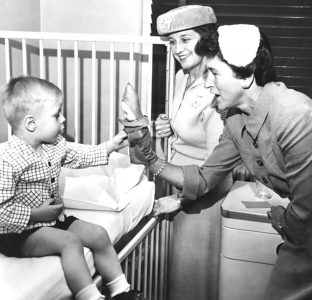
NEW SERVICES included the book cart, baby photo service and Pinkie Puppets, thousands of which were hand-sewn over the next 20 years and given to every pediatric patient. The surgical dressings committee still met twice monthly to sew bandages. A Remembrance Fund was created and promoted.
The annual Friendship Tea began in the 1950s to recognize member service. The Review ran long lists of those who received 50 and 100 hour pins, with a photo of top honorees. Some 106 were honored at the 1957 Friendship Tea, Mrs. Lettie Hunsicker received her 1,000 hours pin, and it was announced that 15,104 hours had been served. Among honored guests was Miss Nell Robinson, City Hospital superintendent from 1929 to 1971, who had a sleeping room just off the ER so she could be there 24 hours a day.
In 1954 the Auxiliary showed its social conscience, pledging in new formal bylaws "to perform services for the patients regardless of race, color or creed."
Increased income allowed the Auxiliary to pick items to fund from the administration's "wish list: $1,500 for men's ward beds in 1958, $1,050 for chapel furnishings in 1960, $18,087 toward second floor redecorating in 1962, $10,000 for the ICU in 1965.
It paid $5,559 in 1966 as half the cost of renovating and expanding the snack bar/gift shop.
HANNAH TURK GREENBURG put a charge into the Auxiliary as president in 1972-74.
The Auxiliary pledged $100,000 toward a new six-story East Wing, the largest single gift toward a $1 million campaign goal. When the $10 million East Wing was completed in 1977, a new snack bar /gift shop greeted visitors near the main entrance.
Sandy Bartolovich in the gift shop and Phyllis Mercer as snack bar manager were among Auxiliary leaders who kept the facility well stocked and staffed with volunteers.
Auxiliary volunteers staffed the front reception desk, a major commitment of time. New services such as taking around a gift cart with books and sundries to patients.
The annual Christmas Bazaar was launched in the mid-1970s, featuring unique and handmade items donated by members and supporters. Jane Vodrey hosted the first bazaar in her home and later hosted the Shoppers Preview in the Octagon House and other sites in historic Fredericktown.
At the Preview, held some weeks before the bazaar, people could choose craft items customized and made to order for pickup at the bazaar, held at the country club in October.
Hans Hacker donated paintings and Jonathan Parry gave custom jewelry to be chanced off at the bazaars.
By 1980 Auxiliary active membership was at a peak, 250, with 150 associate members. The bazaar was bringing in an average of $11,000 a year. So many attended that table reservations for three luncheon times were required.
The bazaar would remain a huge social event as well as a fundraising success over four decades, but also required year-round work and planning.
NEW IDEAS FOR fundraising were tried.
One of the more ambitious was a raffle in which a single ticket won two new cars, "a fancy car and a medium car," as Phyllis "Phyl" Pelini put it. Pelini was recruited by Hannah Greenburg to run it.
A new 1991 Chrysler Imperial and a LeBaron were to come from Basil Mangano's Chrysler Dodge dealership in Newell. "Basil said, 'Do you have enough money for the cars?' I said no, but we'll get it," Pelini said.
The Auxiliary ran the two-car raffle again in 1992 with cars from Buckman Buick Chevrolet Cadillac.
"We made a ton of money," Sally Sayle said.
A long-term source of revenue - and one uniquely not requiring great effort – fell into the Auxiliary's lap when Harvey Grossman, head of food services at the hospital, suggested revenue from hospital pop machines be channeled through the Auxiliary instead of the hospital for tax reasons. By 1981, three years' sales earned $10,000.
Fundraising and society mingled in July 1994 with a black-tie Orchid Gala Ball featuring a Pittsburgh jazz orchestra and fresh orchids everywhere, compliments of Chuck Bosco of Riverview Florists. Over 900 copies of an "Art of Food" cookbook were sold featuring member recipes and color prints of Hans Hacker paintings. Attendees wore Alice in Wonderland costumes for "A Mad Hatter's Tea Party" in 2014.
Event fatigue was evident in 2000 when supporters were sent invitations to a Spring No-Fling non-event, "requesting the honor of your money for the privilege of not attending."
Book sales, jewelry sales and uniform sales inside the hospital - turn-key funders with vendors doing most of the work and employees able to shop at work, were tried in the 2000s. Tickets for a $5,000 cash drawing were sold in 2001, helping pay a $135,000 pledge toward nearly all the cost of renovating the skilled nursing unit.
The hospital was given $142,902 in 1981 for projects including new physical therapy and cardiac rehab units. In 1983 the Auxiliary gave $70,000 to equip the new Lifeline service. Free installation of 90 units in homes was performed at no cost for the first number of years by one man: Donald E. Miller of the Calcutta Lions Club.
For all her efforts, Hannah Greenburg was honored for volunteer excellence in 1986 and again in 1988 by the American Hospital Association at its annual conference.
"Mrs. Greenburg has been a vital force behind East Liverpool City Hospital's volunteer programs for 20 years," the AHA said, noting she also served as a hospital trustee for nine years, twice as chairman.
In 1992 the hospital launched a $9 million renovation that included a new entrance for City Hospital. Hannah Greenburg was tapped once again, co-chaired a $1 million public campaign with Tom Ash. The Auxiliary made a $415,000 pledge, for which it received the Outstanding Civic Organization Award in 1994 from the Eastern Ohio Chapter of the National Society of Fund Raising Executives. Phyl Pelini accepted the award at the Avalon Inn in Warren
"THE PEOPLE," was the common answer when Auxilians were asked what they will miss the most.
"I worked at the snack bar and gift shop cash register," said Jeannie Wicks. "People who came in would lay out all their problems. They just needed someone to talk to."
Nurse Vera Sirianni, 80, retired after 40 years in the surgical department, then returned to volunteer as a surgical hostess for 15 years.
Said Sirianni, "I wanted to give back to the hospital, and I wouldn't have been there if I hadn't liked meeting the people."
"The part I liked so well was I got to work with the volunteers who were wonderful, wonderful people, who wanted to do something with their time that was meaningful," Pelini said.
Megan Hoffrichter Hernandez, who had followed her mother Cindy in Auxiliary service like so many Auxilians, is its last president.
The last major gift to the hospital was $30,000 in 2017 to buy all new equipment in the cardiac rehabilitation.
She said the board voted to distribute remaining funds to community organizations including the Fawcett Foundation, Thompson Park, F.I.S.H., and Mayor Bricker's Potters Progress Fund, and partnered with Kent State-East Liverpool to give 500 children's books to Beaver Local Elementary, North Elementary, LaCroft Elementary and Head Start.
"East Liverpool City Hospital extends our sincerest, heartfelt appreciation to the East Liverpool City Hospital Auxiliary for its years of dedication to our hospital and community." said Rick Perez, Director of Marketing & Business Development for East Liverpool City Hospital. "The rich history and legacy created will never be forgotten. The Auxiliary has not only dedicated countless volunteer hours to our hospital, but it has also contributed to its development through donations made over its years of service. These donations have contributed to what East Liverpool City Hospital is today.
"As we move forward into 2021, it is our goal to continue to develop our volunteer program at East Liverpool City hospital, but we will put the health and safety of our employees, volunteers, and community first and we will take every precaution necessary to keep everyone healthy and safe as we navigate through this pandemic."